MC
MandarinClips Cinema Corpus
HSK 3 Listening Practice: Free Authentic Cinema Dialogue Clips (2026)

HSK 3 Listening Practice: Free Authentic Cinema Dialogue Clips (2026)

Passing the listening section of HSK 3 is no longer about matching sterile robotic vocabulary to textbook multiple-choice options. Under the HSK 3.0 standard, tests evaluate your ability to decode natural spoken rhythm, connected speech, and communicative intent. When native speakers speak at normal speed, syllables blend together, tone sandhi occurs organically, and high-frequency colloquial phrases carry heavy emotional subtexts. Here is your intensive listening workout for HSK 3, featuring authentic dialogue snippets directly from Chinese cinema. ...

November 4, 2026 · 3 min · MandarinClips Team
HSK 4 Listening Practice: Free Authentic Cinema Dialogue Clips (2026)

HSK 4 Listening Practice: Free Authentic Cinema Dialogue Clips (2026)

Passing the listening section of HSK 4 is no longer about matching sterile robotic vocabulary to textbook multiple-choice options. Under the HSK 3.0 standard, tests evaluate your ability to decode natural spoken rhythm, connected speech, and communicative intent. When native speakers speak at normal speed, syllables blend together, tone sandhi occurs organically, and high-frequency colloquial phrases carry heavy emotional subtexts. Here is your intensive listening workout for HSK 4, featuring authentic dialogue snippets directly from Chinese cinema. ...

November 4, 2026 · 3 min · MandarinClips Team
HSK 5 Listening Practice: Free Authentic Cinema Dialogue Clips (2026)

HSK 5 Listening Practice: Free Authentic Cinema Dialogue Clips (2026)

Passing the listening section of HSK 5 is no longer about matching sterile robotic vocabulary to textbook multiple-choice options. Under the HSK 3.0 standard, tests evaluate your ability to decode natural spoken rhythm, connected speech, and communicative intent. When native speakers speak at normal speed, syllables blend together, tone sandhi occurs organically, and high-frequency colloquial phrases carry heavy emotional subtexts. Here is your intensive listening workout for HSK 5, featuring authentic dialogue snippets directly from Chinese cinema. ...

November 4, 2026 · 3 min · MandarinClips Team
HSK 6 Listening Practice: Free Authentic Cinema Dialogue Clips (2026)

HSK 6 Listening Practice: Free Authentic Cinema Dialogue Clips (2026)

Passing the listening section of HSK 6 is no longer about matching sterile robotic vocabulary to textbook multiple-choice options. Under the HSK 3.0 standard, tests evaluate your ability to decode natural spoken rhythm, connected speech, and communicative intent. When native speakers speak at normal speed, syllables blend together, tone sandhi occurs organically, and high-frequency colloquial phrases carry heavy emotional subtexts. Here is your intensive listening workout for HSK 6, featuring authentic dialogue snippets directly from Chinese cinema. ...

November 4, 2026 · 3 min · MandarinClips Team
Authentic Cinema Materials for CFL/TCSL Teachers: Classroom Video & MCP

Authentic Cinema Materials for CFL/TCSL Teachers: Classroom Video & MCP

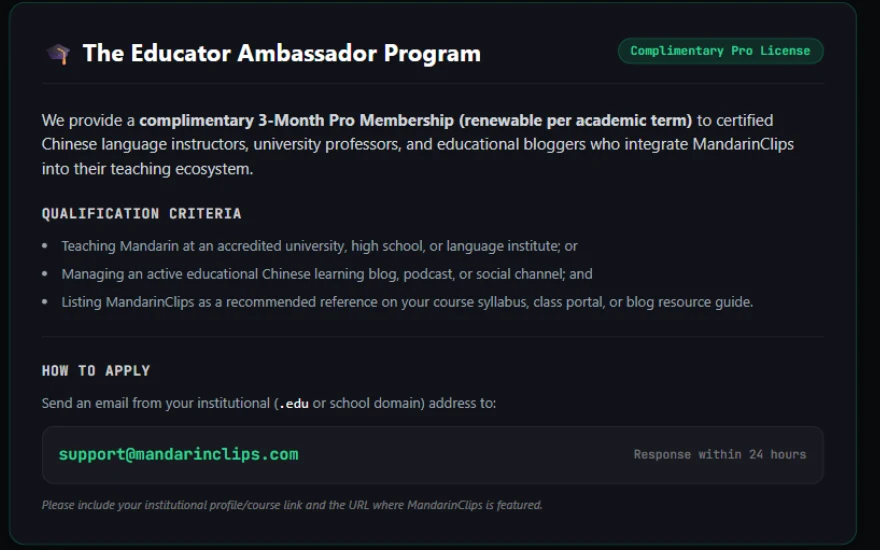
For Chinese language educators (TCSL / CFL), finding authentic, culturally appropriate video examples to illustrate grammar patterns in PowerPoint or Google Slides is historically one of the most time-consuming parts of lesson prep. MandarinClips was engineered with educators in mind: Pedagogical Concordancing: Search 180,000+ 3-second clips indexed by official HSK 3.0 grammar formulas. Classroom-Safe Video Citations: Export high-resolution dialogue clips formatted directly for Keynote and PowerPoint. AI & MCP Integration: Native support for the Model Context Protocol (MCP), allowing instructors to generate tailored lesson plans with real cinema citations directly inside Claude. 👉 **[Discover teacher tools and classroom video assets ...

November 4, 2026 · 1 min · MandarinClips Team
HSK 2.0 vs HSK 3.0: What Actually Changed Level-by-Level?

HSK 2.0 vs HSK 3.0: What Actually Changed Level-by-Level?

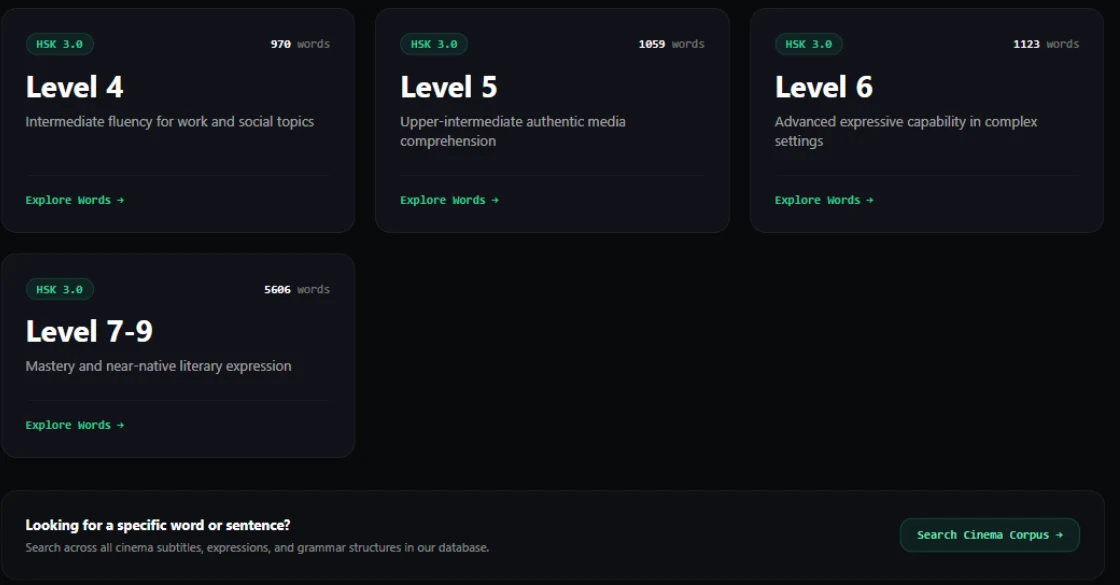
In 2021, the Ministry of Education unveiled the HSK 3.0 grading standards. The old 6-level structure was officially replaced with a 3-stage, 9-level system. Key Differences: Vocabulary Inflation: Old HSK 6 required 5,000 words. New HSK 6 requires 5,456 words, while the complete 9-level syllabus demands 11,092 words. Handwriting Requirement: Elementary and intermediate levels now enforce character handwriting benchmarks. Oral and Translation Testing: Advanced levels (7–9) integrate simultaneous interpreting and professional translation tasks. The new 9-level structure in practice on MandarinClips: Levels 4-6 now demand 970-1,123 words each, and the new combined 7-9 band adds 5,606 more entries for near-native literary expression. 👉 Bridge the gap to HSK 3.0 with authentic native media on MandarinClips →

November 4, 2026 · 1 min · MandarinClips Team
How Long Does It Take to Pass Each HSK Level? (2026 Empirical Data)

How Long Does It Take to Pass Each HSK Level? (2026 Empirical Data)

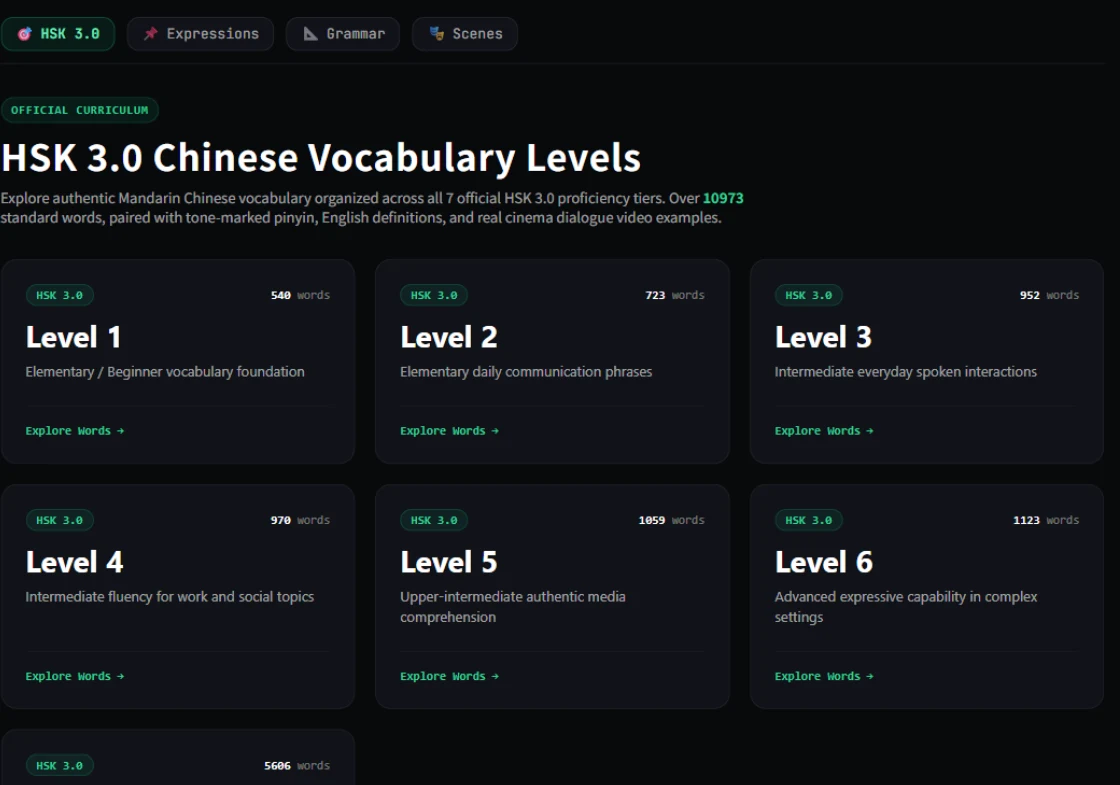
How many active hours does it realistically take to pass each level under the HSK 3.0 framework? Based on data synthesized from the US Foreign Service Institute (FSI), official Hanban guidelines, and tracking data from hundreds of independent language immersion learners, here are the empirical benchmarks. The Realistic Study Hours Matrix HSK Level Active Hours (Textbook Only) Active Hours (With Media Immersion) CEFR Equivalent Functional Spoken Fluency HSK 1 100 – 150 hours 60 – 100 hours Pre-A1 Survival greetings, numbers, taxi directions. HSK 2 250 – 350 hours 150 – 220 hours A1 Simple dining, scheduling, basic shopping. HSK 3 450 – 600 hours 300 – 420 hours A2 Independent travel, expressing simple feelings. HSK 4 800 – 1,200 hours 550 – 800 hours B1 Following modern C-dramas with Chinese subs. HSK 5 1,500 – 2,200 hours 1,000 – 1,500 hours B2 Complex workplace discussions, adult relationships. HSK 6 2,500 – 3,500 hours 1,800 – 2,500 hours C1 Full professional and public debate autonomy. HSK 7–9 4,000 – 6,000+ hours 3,000 – 4,500 hours C2 Native-equivalent literary and academic fluency. The full HSK 3.0 ladder on MandarinClips: seven tiers from Level 1 (540 words) to the combined 7-9 band (5,606 words), every entry corpus-ranked. Why Media Immersion Cuts Study Hours by 35% Learners relying purely on grammar exercises and textbook drills hit a severe plateau between HSK 3 and HSK 4. They know grammar rules intellectually, but their brains cannot decode fast spoken Mandarin in real time. ...

November 4, 2026 · 2 min · MandarinClips Team
Complete HSK 3.0 Vocabulary List: All 9 Levels with Cinema Dialogue Examples

Complete HSK 3.0 Vocabulary List: All 9 Levels with Cinema Dialogue Examples

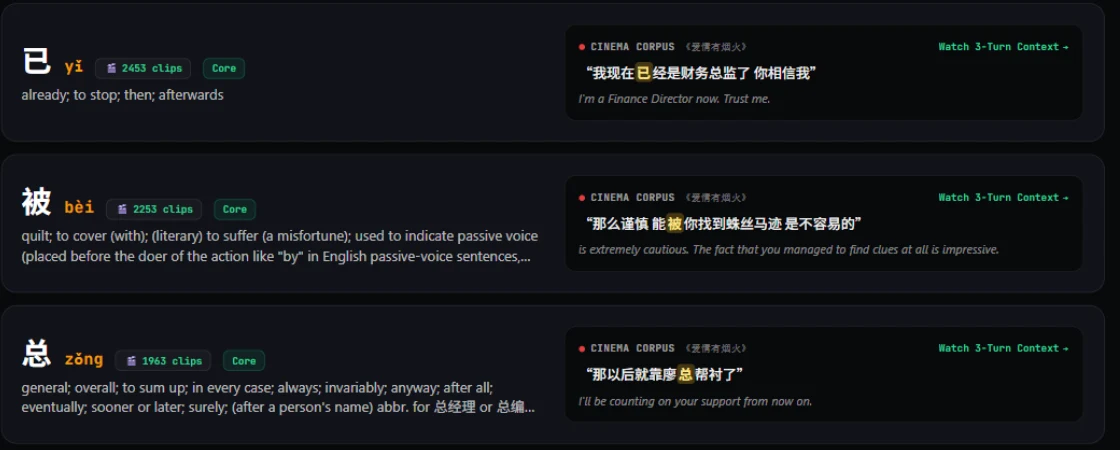
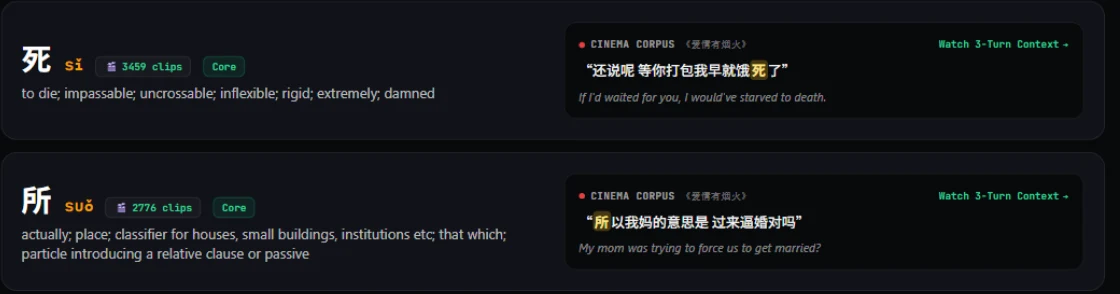
Under the official HSK 3.0 (Chinese Proficiency Grading Standards), the cumulative vocabulary spans 11,092 entries across 9 levels. Memorizing static spreadsheet word lists fails because over 40% of Chinese words shift meaning based on emotional delivery, social status, and cultural subtext. Here is the authoritative level-by-level distribution of the HSK 3.0 lexicon and how to study them through authentic cinema dialogue. Cumulative Vocabulary by Level Band Level New Words Cumulative Total Daily Conversational Coverage Elementary (初等) HSK 1 500 words 500 words Basic survival greetings, transactions, and food. HSK 2 772 words 1,272 words Public transit, daily schedules, shopping, weather. HSK 3 973 words 2,245 words Autonomous daily travel, hobbies, interpersonal chats. Intermediate (中等) HSK 4 1,000 words 3,245 words Modern C-dramas with subtitles, social issues. HSK 5 1,071 words 4,316 words Workplace debate, complex connectors, adult relationships. HSK 6 1,140 words 5,456 words Formal public discourse, news media, academic essays. Advanced (高等) HSK 7–9 5,636 words 11,092 words Full native literary, legal, political, and cultural fluency. Every entry in the database carries its real cinema clip count — HSK 3 words like 已 (yǐ), 被 (bèi), and 总 (zǒng) each appear in 2,000+ authentic scenes. Why Single-Word Flashcards Lead to Awkward Chinese Take the common HSK 3 verb 算 (suàn): ...
November 4, 2026 · 2 min · MandarinClips Team
HSK 8-9 Advanced Discourse & Pragmatics: Master Native Cinema Fluency

HSK 8-9 Advanced Discourse & Pragmatics: Master Native Cinema Fluency

Preparing for modern Chinese proficiency requires aligning official HSK 3.0 standards with authentic native speech. This comprehensive guide breaks down HSK 8-9 Advanced Discourse & Pragmatics: Master Native Cinema Fluency, providing task-based syllabus overviews, high-frequency grammatical patterns, and authentic cinema dialogue citations. Core Highlights Official Standards: Aligned with the 2025/2026 HSK 3.0 syllabus and communicative tasks. Linguistic Concordancing: Replacing artificial textbook sentences with authentic native speech from real cinema. Pragmatic Context: Understanding speaker hierarchy, emotional tone, and communicative subtexts. 🎬 Real Cinema Dialogue Demonstration: Watch how native actors employ target grammar structures at native conversational tempo. ...

November 4, 2026 · 1 min · MandarinClips Team
The Psychology of 客气 (Kèqi): Chinese Politeness and Social Modesty

The Psychology of 客气 (Kèqi): Chinese Politeness and Social Modesty

In Chinese culture, politeness is not a static word—it is an interactive ritual known as 客气 (kèqi). Literally meaning “guest air / guest demeanor”, 客气 governs how hosts treat guests, how diners fight over restaurant bills, and how compliments must be ritually deflected. Understanding 客气 is the dividing line between an outsider and someone who truly understands Chinese social psychology. The 3 Pillars of 客气 1. Deflecting Compliments (Modesty) When someone compliments your Chinese (“你中文说得太好了!”), never say “谢谢”. That sounds arrogant. ...

November 3, 2026 · 1 min · MandarinClips Team