If you ask Mandarin communities on Reddit or Discord for the best app to build vocabulary, Du Chinese is almost always at the top of the recommendation list.
With its meticulously leveled graded stories (from newbie to HSK 9) and professional voice-actor recordings, Du Chinese has solved the problem of extensive reading for thousands of learners.
However, many learners who spend months reading Du Chinese stories run headfirst into the “Literacy Trap”:
- You can comfortably read a 1,000-character story on your phone.
- But when you step off the plane in Shanghai, tune into a modern C-drama, or chat with a native speaker over coffee, you can barely catch every third word.
- When you speak, native friends tease you that you sound like a formal 19th-century newspaper or an audio announcer.
Reading controlled text in a quiet room does not automatically translate to understanding rapid, emotionally charged native speech.
Below is an honest, side-by-side comparison of Du Chinese and MandarinClips, highlighting their fundamental differences, unique strengths, and how to combine them for maximum fluency.
Quick Comparison: Du Chinese vs MandarinClips
| Feature | Du Chinese | MandarinClips |
|---|---|---|
| Primary Medium | Controlled Graded Written Stories (Text) | Authentic Cinema & TV Dialogue Snippets (Video) |
| Primary Skill Built | Character reading literacy & written grammar | Spoken listening comprehension, cadence & pragmatics |
| Audio Source | Professional voice actors (Studio clarity) | Real native actors in award-winning films |
| Speech Speed & Delivery | Articulated, clear, controlled pace | Full native tempo, emotional inflection & slurred speech |
| Concordancing / Search | Browse stories chapter by chapter | Instant reverse search across 180,000+ clips |
| Cultural Pragmatics | Narrative explanations of story plot | Explicit annotations of conversational subtext (潜台词) |
| Price | Free limited stories / $14.99/mo Pro | Robust free search / Affordable Pro tier |
| Best For | Beginners & intermediate learners mastering characters | Learners (HSK 2–9) transitioning to real spoken fluency |
What Du Chinese Does Best
[https://www.mandarinclips.com/og-image.jpg]
There is a reason Du Chinese is so widely respected. For text-based comprehensible input, it has few equals:
- Controlled Vocabulary Progression: Stories are written strictly within HSK boundaries. If you read an HSK 2 story, you rarely encounter rogue advanced vocabulary that ruins your reading flow.
- Pristine Studio Audio: Every sentence is narrated by native professional voice artists with flawless standard Mandarin (普通话). The recording quality is crystal clear, making it a peaceful, low-stress companion before bed.
- One-Tap Dictionary & Sentence Translation: Tapping any word displays its pinyin and English definition, while tapping a sentence reveals a clean English translation.
If your primary goal is mastering Chinese characters, expanding reading speed, and absorbing written narrative structures, Du Chinese is fantastic.
Where Du Chinese Leaves a Gap (And Why MandarinClips Exists)
Despite its brilliance, Du Chinese is constrained by its medium: it is written language, not living speech.
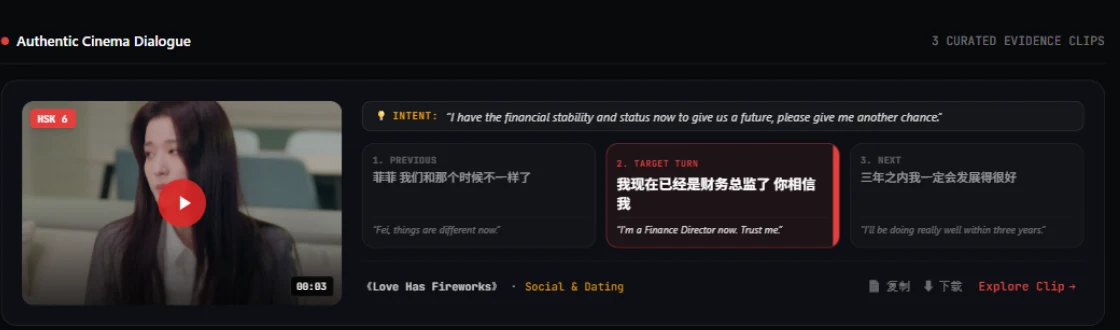
Real human conversation does not sound like a studio-recorded audiobook. In real life:
- Native speakers slur syllables (e.g., “不知道” frequently sounds like “不道 / búdào”).
- People use pregnant pauses, ironic sighs, and facial body language.
- High-frequency colloquial reactions like “算了” (suàn le) or “折腾” (zhēteng) derive 80% of their meaning from vocal tone and interpersonal hierarchy (面子).
This is where MandarinClips takes over:
1. Authentic Native Speed and Acoustic Reality
Instead of sanitized studio recordings, MandarinClips indexes over 180,000 real dialogue clips (~3 seconds each) from acclaimed contemporary Chinese films and television. You hear real people shouting in noisy restaurants, whispering in quiet offices, and bickering in traffic jams.
2. Instant Dialogue Concordancing
In Du Chinese, you must read whatever story the editors published.
With MandarinClips, you have an active pedagogical concordancer. When you want to understand how native speakers use a tricky word like “至于吗” or “哪怕\dots也\dots”, you don’t wait for it to appear in a story. You type it in, and the engine immediately presents 20 different real movie scenes showing 20 different actors delivering that line in context.
3. Pragmatic Subtexts (潜台词)
Du Chinese translates the literal plot. MandarinClips explains the unspoken cultural subtext:
🎬 Real Cinema Comparison:
A character in an office drama says: “这件事我们回头再讨论吧。”
- Du Chinese / Textbook Translation: We will discuss this matter again when we turn around.
- MandarinClips Pragmatic Annotation: The speaker is using polite avoidance. In 90% of Chinese professional situations, “回头再讨论” is a face-saving, non-negotiable “No.”
Side-by-Side: Which Tool Fits Your Current Goal?
Choose Du Chinese if:
- You are an absolute beginner or elementary learner (HSK 1–3) focusing heavily on character recognition and reading stamina.
- You want to relax and read complete multi-chapter fictional stories with audio accompaniment on your commute.
- You prefer controlled, perfectly enunciated studio speech without background noise.
Choose MandarinClips if:
- You can read textbooks, but you struggle to understand real Chinese speakers, movies, or C-dramas at native speed.
- You want to stop sounding like a walking formal textbook and master natural colloquial phrasing, reactions, and slang.
- You are studying for HSK 3.0 and need to see how official grammar patterns operate in real-life communicative tasks.
- You want to reverse-search specific vocabulary across a massive 180k+ cinema corpus in seconds.
The Pro Workflow: Combining Both for Rapid Acquisition
You don’t actually have to pick one over the other. The most effective independent learners pair them together:
- Morning Reading (Du Chinese): Spend 15 minutes reading an HSK story to build character recognition and extensive reading stamina.
- Vocabulary Extraction: When you encounter a high-frequency spoken phrase or confusing connector in your reading (e.g., “倒霉”, “反倒”, “何必”), don’t just memorize the flashcard definition.
- Cinema Concordancing (MandarinClips): Search the word on MandarinClips. Watch 5 real actors speak the phrase in short 3-second clips to hear the vocal inflection and absorb the real-world subtext.
- Shadowing: Replay one clip three times and speak it aloud with the actor’s exact cadence.
Break Free from the Textbook Bubble
Reading graded stories builds a wonderful foundation, but language is meant to be heard, felt, and spoken.
Ready to see how real native speakers talk in modern cinema?
👉 Search your first word across 180,000+ movie clips on MandarinClips for free →