Chinese television dramas (C-dramas) are arguably the richest source of natural, contemporary Mandarin input on the planet. From family sagas like 《都挺好》 (All Is Well) to atmospheric thrillers like 《隐秘的角落》 (The Bad Kids), modern shows expose you to how Chinese speakers truly laugh, argue, negotiate, and fall in love.
Yet hundreds of thousands of learners fall into the classic “Subtitle Illusion”:
- You curl up on the couch to watch 40 episodes of a gripping drama on Netflix or Viki.
- You keep dual subtitles or English subtitles turned on.
- At the end of the season, your brain followed the plot perfectly, but your spoken Mandarin hasn’t improved by a single percentage point.
Watching full-length dramas without a framework is like swimming in an open ocean without knowing how to paddle—you drown in rapid native speech.
To transform your binge-watching habit into rapid conversational fluency, here is the definitive, research-backed C-drama immersion routine for 2026.
The Golden Rule: Choose the Right Genre (Avoid the Costume Trap)
[https://www.mandarinclips.com/og-image.jpg]
The single biggest mistake beginners make is choosing Historical (古装) or Fantasy (仙侠 / 玄幻) dramas like 《琅琊榜》 (Nirvana in Fire) or 《苍兰诀》 (Love Between Fairy and Devil).
While these shows are visually breathtaking, their dialogue is packed with:
- Archaic Classical Chinese (文言文) structures.
- Elaborate courtly honorifics (“微臣”、“启奏陛下”) that will make you sound absurd in a modern Beijing coffee shop.
- Fictional martial arts jargon that does not exist in daily life.
Recommended C-Drama Genres for Real Fluency:
| Level | Ideal Genre | Why It Works | Recommended Shows |
|---|---|---|---|
| HSK 2–3 | Slice-of-Life & Youth Romance | Simple, repetitive daily vocabulary; clear vocal delivery. | 《致我们单纯的小美好》 (A Love So Beautiful), 《暗格里的秘密》 (Our Secret) |
| HSK 3–4 | Healing & Travel Dramas | Natural, relaxed pacing; practical conversational exchanges. | 《去有风的地方》 (Meet Yourself) |
| HSK 4–5 | Modern Urban & Family Dramas | Authentic domestic arguments, colloquial slang, and face-saving subtext. | 《都挺好》 (All Is Well), 《小欢喜》 (A Little Reunion) |
| HSK 5–6 | Workplace & Realistic Crime | Fast-paced adult negotiation, social power dynamics, and formal discussion. | 《狂飙》 (The Knockout), 《装腔启示录》 (Fake It Till You Make It) |
The 4-Step C-Drama Immersion Routine
To turn a 45-minute episode into actual language gains, do not watch passively from start to finish. Follow this 4-step framework:
Step 1: Active Micro-Mining (Focus on 5 Minutes, Not 45)
Choose a single 3-to-5-minute conversational scene—preferably an argument, a dinner dialogue, or an office negotiation.
Turn off English subtitles. Watch the scene twice with only Chinese characters (汉字) and focus on identifying:
- High-frequency conversational connectors (e.g., “哪怕”、“反而”、“话说回来”).
- Emotional reaction words (e.g., “算了”、“至于吗”、“得了吧”).
Step 2: Decode the Pragmatic Subtext (潜台词)
Textbook translations tell you the literal meaning of words. Real C-dramas teach you what people actually mean.
Notice how characters use indirect phrasing to maintain social harmony (面子):
🎬 Real Scene Breakdown (《去有风的地方》/ Meet Yourself)
Context: A neighbor politely offers home-cooked treats to a newcomer.
Neighbor: 自家种的果子,顺路带给你们尝尝,不值什么钱。
Newcomer: 那怎么好意思呢,太麻烦您了!
- Literal: Fruit from our garden, brought along the way for you to taste, not worth any money. / How could I have the face, too troublesome for you!
- Pragmatic Subtext: The giver deliberately downplays their gift (“不值什么钱”) so the recipient doesn’t feel burdened by reciprocal debt (人情). The receiver must protest modesty (“怎么好意思”) before accepting.
Step 3: Concordance the Target Phrase Across Cinema
When you hear an unfamiliar colloquial phrase (like “折腾” or “硬着头皮”), hearing it once in a single episode is not enough to cement it in your memory.
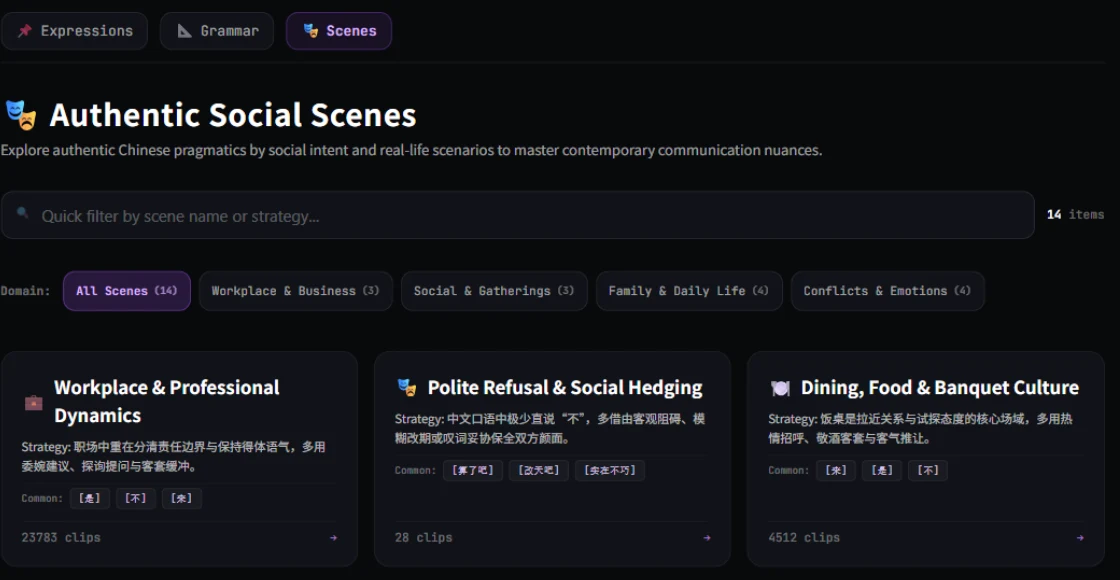
Take the phrase and search it on MandarinClips. In less than two seconds, you can watch 10 to 20 different 3-second clips of that exact phrase delivered by different actors across completely different movies and TV shows.
Seeing the same word used in an office dispute, a romantic breakup, and an everyday grocery market trip builds intuitive contextual mastery.
Step 4: Shadow the Dialogue with Real Emotion
Choose one memorable 3-second clip from the scene.
- Listen to the actor’s vocal inflection. Where does their voice drop? Where do they hesitate?
- Repeat the line out loud at the exact same speed and emotional pitch as the actor.
- Do not read the subtitle text mechanically—mimic their sigh, chuckle, or facial tension.
Shadowing real cinematic dialogue rewires your muscle memory and breaks the robotic, monotone rhythm typical of textbook learners.
3 Essential Tools for C-Drama Learners in 2026
- Streaming Platforms with Chinese Subtitles:
- Netflix: Excellent selection of modern C-dramas with synchronized Hanzi tracks.
- iQiyi & WeTV: Vast libraries of the latest native Chinese television broadcast simultaneously with domestic releases.
- Interactive Subtitle Extensions:
- Language Reactor & Trancy: Great for dual subtitles during initial viewing runs. (Check out our comparison of the best Language Reactor alternatives).
- Dialogue Concordancer & Corpus:
- MandarinClips: The ultimate bridge. When you don’t have 45 minutes to hunt for a word, search 180,000+ scene clips instantly to master spoken phrasing in context.
Stop Watching Passively
The secret to mastering spoken Chinese isn’t logging 500 hours of mindless drama viewing—it’s treating dialogue as a living linguistic goldmine.
Isolate short scenes, decode the cultural subtext, and practice shadowing real native speech.
Ready to practice with real cinema clips?
Search over 180,000 dialogue clips on MandarinClips for free →