MC
MandarinClips Cinema Corpus
Textbook Chinese vs Real Chinese: 15 Embarrassing Mistakes Learners Make

Textbook Chinese vs Real Chinese: 15 Embarrassing Mistakes Learners Make

Most Mandarin curricula teach a formal, sanitized version of the language that hasn’t changed since the 1980s. When students try using these phrases on the streets of Chengdu or Beijing, native speakers look at them with polite confusion. Here are the 15 most common textbook phrases and their real-world cinema equivalents. The 15 Replacements # What Textbooks Teach What It Sounds Like What Native Speakers Actually Say 1 你好吗? (Nǐ hǎo ma?) “Greetings, are you physically intact?” 吃了吗? / 最近怎么样? / 干嘛呢? 2 请问您贵姓? (Qǐngwèn nín guìxìng?) Ancient imperial court inquiry (to peers). 怎么称呼您? / 怎么称呼? 3 再见! (Zàijiàn!) Heavy, formal farewell. 拜拜! / 走了啊! / 回头聊! 4 不用谢。 (Bù yòng xiè.) Robotic broadcast announcer. 没事儿! / 客气啥! / 小事! 5 哪里哪里。 (Nǎli nǎli.) 19th-century modest scholar. 没有没有! / 还可以吧! / 您过奖了! 6 我非常高兴。 (Wǒ fēicháng gāoxìng.) Grade-school essay writing. 太开心了! / 爽! / 挺乐呵的! 7 请问洗手间在哪里? Stiff grammar. 打扰一下,洗手间在哪儿? 8 我不赞同你的看法。 Diplomatic debate confrontation. 我感觉这事儿可能有点悬… 9 没关系。 (When declining food) Inappropriate reassurance. 不用了,谢谢! 10 太贵了,便宜点吧。 Aggressive, clumsy haggling. 老板,给个实诚价呗! 11 我想买这个。 Clunky textbook declarative. 这个怎么卖? 12 请原谅我。 Begging for royal pardon. 不好意思啊,真抱歉! 13 我们明天见。 Rigid schedule notification. 明儿见! 14 非常感谢你的帮助。 Formal diplomacy letter. 这次真多亏你了! 15 我不明白。 Clinical lack of comprehension. 没太懂你意思 / 怎么说? 👉 **[Hear real conversational Chinese in 180,000+ film clips ...


November 3, 2026 · 2 min · MandarinClips Team
20 Essential Chinese Filler Words: Sound Like a Native Between Sentences

20 Essential Chinese Filler Words: Sound Like a Native Between Sentences

When non-native speakers pause to think, they often produce unnatural English sounds (“uh…”, “um…”) or freeze in dead silence. Native Mandarin speakers rarely stay silent. They bridge conversational pauses with verbal lubricants (填充词 / Filler Words). Mastering these 20 filler words instantly makes your Mandarin sound 50% more natural. The Top 5 Universal Chinese Fillers 1. 那个 (nàge / nèige) Function: The ultimate Chinese equivalent of “um” or “that thing…”. Usage: Used when searching for a word or opening an informal request. “我想问一下,那个,明天的会议几点开始?” ...

November 3, 2026 · 2 min · MandarinClips Team
How to Use 至于吗 (Zhìyú ma) and 哪跟哪啊: Master Native Chinese Reactions

How to Use 至于吗 (Zhìyú ma) and 哪跟哪啊: Master Native Chinese Reactions

In spoken Chinese, native speakers love quick, punchy rhetorical deflators. Two of the most common are 至于吗 (zhìyú ma) and 哪跟哪啊 (nǎ gēn nǎ a). If you only rely on dictionary definitions, you miss their emotional velocity: 至于 (zhìyú): As for; to go so far as to. 哪 (nǎ): Where / which. In living dialogue, however, they represent two of the most natural conversational shields in modern Mandarin. 1. 至于吗 (zhìyú ma): “Are You Seriously Overreacting That Much?” Use “至于吗” when someone makes a catastrophic scene over a minor inconvenience. ...

November 3, 2026 · 2 min · MandarinClips Team
Chinese Sarcasm and Irony: How Native Speakers Deliver Cold Humor in Cinema

Chinese Sarcasm and Irony: How Native Speakers Deliver Cold Humor in Cinema

A common myth among beginner Mandarin students is that Chinese culture is too earnest, hierarchical, or formal for sarcasm and dry irony (反讽 / fǎnfèng). Spend ten minutes watching modern Chinese cinema, and that misconception evaporates. From Beijing dark comedies to sharp urban workplace dramas, native Mandarin speakers are masters of deadpan sarcasm. The challenge for learners is that Chinese irony rarely relies on exaggerated vocal changes. Instead, it is delivered with a flat tone, a slight smirk, or a polite smile—using praise to deliver a verbal punch. ...

November 3, 2026 · 3 min · MandarinClips Team
How to Say No in Chinese: The Art of Face (面子) and Polite Refusals

How to Say "No" in Chinese: The Art of Face (面子) and Polite Refusals

In Western business and social communication, directness is valued: “No, I cannot attend,” or “I disagree with that proposal.” In Mandarin Chinese, however, delivering a blunt, naked “不” (bù) to an invitation or business request is the conversational equivalent of slamming a door in someone’s face. It violates the core pillar of Chinese interpersonal pragmatics: Saving Face (面子 / miànzi). When you deliver a flat rejection, you do not just decline a request—you publicly strip the requester of their social dignity, leaving both parties embarrassed (难堪). ...

November 3, 2026 · 3 min · MandarinClips Team
How to Learn Chinese from C-Dramas (Cdrama): The Ultimate 2026 Immersion Routine

How to Learn Chinese from C-Dramas (Cdrama): The Ultimate 2026 Immersion Routine

Chinese television dramas (C-dramas) are arguably the richest source of natural, contemporary Mandarin input on the planet. From family sagas like 《都挺好》 (All Is Well) to atmospheric thrillers like 《隐秘的角落》 (The Bad Kids), modern shows expose you to how Chinese speakers truly laugh, argue, negotiate, and fall in love. Yet hundreds of thousands of learners fall into the classic “Subtitle Illusion”: You curl up on the couch to watch 40 episodes of a gripping drama on Netflix or Viki. You keep dual subtitles or English subtitles turned on. At the end of the season, your brain followed the plot perfectly, but your spoken Mandarin hasn’t improved by a single percentage point. Watching full-length dramas without a framework is like swimming in an open ocean without knowing how to paddle—you drown in rapid native speech. ...

November 3, 2026 · 5 min · MandarinClips Team
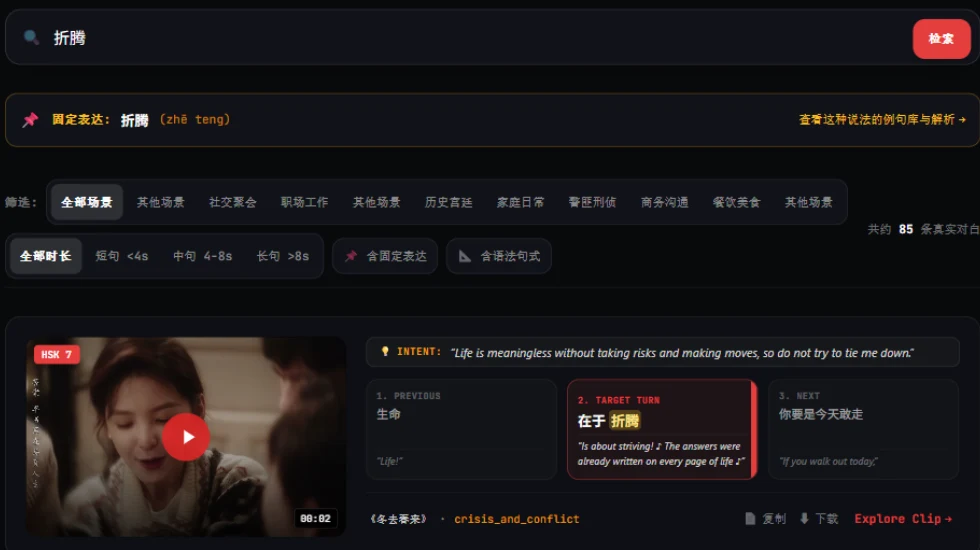
The Many Meanings of 折腾 (Zhēteng): How Native Speakers Actually Use It (With Movie Clips)

The Many Meanings of 折腾 (Zhēteng): How Native Speakers Actually Use It (With Movie Clips)

In late 2008, Chinese political speechwriters presented the world’s diplomatic translators with an impossible riddle. During an official keynote addressing the nation’s modernization, the government announced the core principle of “不折腾” (bù zhēteng). Major international news outlets panicked. The New York Times, BBC, and international linguists spent weeks debating how to translate it: “Do not get sidetracked?” “Avoid self-inflicted chaos?” “Don’t flip-flop or cause unnecessary agitation?” Eventually, many official Chinese diplomatic releases gave up and simply transliterated it as “Buzheteng”. ...

November 2, 2026 · 5 min · MandarinClips Team
How to Say Never Mind in Chinese: 算了 vs 没关系 vs 不用了 (With Real Movie Clips)

How to Say "Never Mind" in Chinese: 算了 vs 没关系 vs 不用了 (With Real Movie Clips)

In English, the phrase “never mind” is a universal multi-tool. You can use it to: Forgive someone who accidentally bumps your elbow (“Never mind, it’s fine”). Drop a point when someone can’t hear you over loud music (“Never mind, I’ll tell you later”). Politely decline a second cup of coffee (“Never mind, I’m good”). Show sharp annoyance when an argument goes nowhere (“Never mind! Forget I even brought it up!”). If you try to translate all of these with a single Chinese phrase, you will run into awkward cultural misunderstandings. ...

November 2, 2026 · 5 min · MandarinClips Team
Top 50 Chinese Colloquial Phrases You'll Never Learn in Textbooks (With Cinema Context)

Top 50 Chinese Colloquial Phrases You'll Never Learn in Textbooks (With Cinema Context)

If you have ever arrived in China or tuned into a modern C-drama after years of studying HSK textbooks, you’ve likely experienced the classic “Textbook Mandarin Disconnect”: You expect someone to say “你好吗?我很好,谢谢你。” Instead, they say “吃了吗?” or a casual “干嘛呢?” When someone wants to de-escalate an awkward dispute, they don’t say “请不要介意”—they snap a sharp “算了” (suàn le). When someone is completely overwhelmed by exhausting complications, you won’t find the feeling in standard vocabulary lists—you will hear native speakers sigh “折腾” (zhēteng). Standard textbooks teach you prescriptive grammar designed for academic essays and formal business meetings. They systematically ignore pragmatics (语用学): the unwritten conversational rules, ironic undertones, facial expressions, and colloquial shortcuts that native speakers rely on every single day. ...

November 2, 2026 · 9 min · MandarinClips Team