In Western business and social communication, directness is valued: “No, I cannot attend,” or “I disagree with that proposal.”
In Mandarin Chinese, however, delivering a blunt, naked “不” (bù) to an invitation or business request is the conversational equivalent of slamming a door in someone’s face. It violates the core pillar of Chinese interpersonal pragmatics: Saving Face (面子 / miànzi).
When you deliver a flat rejection, you do not just decline a request—you publicly strip the requester of their social dignity, leaving both parties embarrassed (难堪).
To navigate friendships, dinners, and corporate negotiations in China, you must master the art of the Polite Indirect Refusal.
Here is how native speakers decline requests smoothly using real cinema dialogue examples.
The 4 Tiers of Indirect Refusal in Spoken Chinese
[https://www.mandarinclips.com/og-image.jpg]
Tier 1: The “Temporal Postponement” (回头再说 / 改天)
Instead of saying “No”, native speakers push the decision into an indefinite, fuzzy future.
- 回头再说 (huítóu zài shuō): “Let’s talk about it later.”
- 改天吧 (gǎitiān ba): “Another day.”
🎬 Real Cinema Dialogue:
Colleague A: 周末要不要一起去近郊露营? (Want to go camping in the suburbs this weekend?)
Colleague B: 回头再说吧,最近手头项目挺紧的。 (Let’s talk about it later, the current project deadline is pretty tight.)
- Pragmatic Subtext: Notice that Colleague B does not promise an alternative date. In 85% of social contexts, “回头再说” is an unspoken, graceful “No thanks.”
Tier 2: The “Conditional Hesitation” (看情况 / 不太好说)
This signals that external, uncontrollable factors prevent you from accepting, completely relieving the requester of personal blame.
- 看情况吧 (kàn qíngkuàng ba): “We’ll see how things look.”
- 这事儿不好说 (zhè shìr bù hǎoshuō): “It’s hard to say right now.”
🎬 Real Cinema Dialogue:
Friend: 晚上的聚餐你能赶过来吗? (Can you make it to the dinner gathering tonight?)
Speaker: 我手头还有两个汇报要改,看情况吧,你们先吃。 (I still have two reports to revise. We’ll see, go ahead and start eating without me.)
- Pragmatic Subtext: “你们先吃” (go ahead and eat) paired with “看情况” signals to the host that they should not reserve a seat.
Tier 3: The “Inconvenience Softener” (不太方便)
When dealing with favors or personal boundaries, state that circumstances are “inconvenient” rather than impossible.
- 这两天不太方便 (zhè liǎng tiān bù tài fāngbiàn): “It’s not very convenient right now.”
Tier 4: The “Proactive Self-Blame” (实在不好意思)
In high-stakes professional or formal contexts, a refusal must be preceded by taking personal emotional responsibility for causing disappointment.
- 真是不巧 (zhēn shì bù qiǎo): “The timing is truly unfortunate.”
- 实在不好意思 (shízài bù hǎoyìsi): “I am truly embarrassed / terribly sorry.”
How to Accept a Refusal Without Forcing an Awkward Scene
Understanding indirect refusals is only half the battle; knowing how to respond when someone uses one on you is equally vital.
When a Chinese friend or colleague says “看情况吧” or “回头再说”, never push for a definite answer:
- ❌ Do not say: “到底去不去?给我个准话!” (Are you going or not? Give me a straight answer!)
- ✅ Do say: “行,那你先忙,随时联系!” (Sounds good, focus on your work, let’s keep in touch!)
Master Cultural Nuance Through Living Media
Cultural subtext cannot be memorized from a vocabulary list. It lives in the speaker’s hesitation, their eye contact, and the conversational dance.
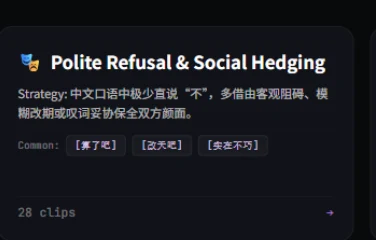
Want to see how Chinese actors balance Face (面子) and boundaries across real film scenes?
👉 Explore authentic conversational subtexts on MandarinClips →