In English, the phrase “never mind” is a universal multi-tool. You can use it to:
- Forgive someone who accidentally bumps your elbow (“Never mind, it’s fine”).
- Drop a point when someone can’t hear you over loud music (“Never mind, I’ll tell you later”).
- Politely decline a second cup of coffee (“Never mind, I’m good”).
- Show sharp annoyance when an argument goes nowhere (“Never mind! Forget I even brought it up!”).
If you try to translate all of these with a single Chinese phrase, you will run into awkward cultural misunderstandings.
Imagine a friend steps on your shoe, apologizes profusely, and you reply with a cold “算了” (suàn le). Instead of comforting them, you just signaled: “I’m annoyed, this conversation is over, and I’m holding a grudge.”
In Mandarin Chinese, how you say “never mind” depends strictly on social etiquette, interpersonal emotion, and cultural face (面子).
Here is how to choose between 算了 (suàn le), 没关系 (méi guānxi), and 不用了 (bù yòng le) using real cinema dialogue examples.
The Cheat Sheet: At a Glance
| Chinese Phrase | Pinyin | True English Equivalent | Emotional Tone | When to Use |
|---|---|---|---|---|
| 没关系 | méi guānxi | “No worries” / “It doesn’t matter” | Warm, reassuring | Forgiving a mistake or reassuring someone who feels guilty. |
| 算了 | suàn le | “Forget it” / “Drop it” | Resigned, dismissive | Giving up on an explanation, de-escalating a dispute, or letting go of an effort. |
| 不用了 | bù yòng le | “No need” / “I’m good” | Polite, boundary-setting | Declining an offer of food, help, or a service. |
| 没事 / 没事儿 | méi shì / méishìr | “I’m fine” / “Don’t sweat it” | Casual, reassuring (or masked irritation) | Minor physical bumps or brushing off inconvenience. |
1. 没关系 (méi guānxi): Forgiveness and Reassurance
[https://www.mandarinclips.com/og-image.jpg]
Use “没关系” when someone apologizes to you, expresses concern, or worries that they caused you trouble. It literally means “there is no relationship / consequence.”
Key Scenarios:
- Responding to 对不起 (duìbuqǐ) or 不好意思 (bù hǎoyìsi).
- Reassuring a host when they apologize for simple food.
- Alleviating someone’s anxiety when plans change unexpectedly.
🎬 Cinema Dialogue: Reassurance
Context: A young intern spills tea on a senior colleague’s desk notes.
Intern: 对不起李老师!我真不是故意的,我帮您重新打印一份! (I’m so sorry, Mr. Li! I didn’t mean to, I’ll reprint a copy for you right away!)
Mr. Li: 没关系,草稿而已,擦干净就行了。 (No worries at all, it was just a draft. Just wipe it clean.)
- Pragmatic Note: Using “没关系” immediately restores social equilibrium and puts the other person at ease.
2. 算了 (suàn le): The Art of Resignation and De-escalation
“算了” literally translates to “calculated / settled.” In daily spoken Chinese, it means to abandon an effort, drop a topic, or resign oneself to an imperfect outcome.
Because “算了” involves an abrupt full-stop, its meaning changes completely depending on your tone of voice:
A. The Peaceful De-escalation (Face-Saving)
When two people disagree and neither wants to cause a public scene, one party will say “算了” to voluntarily step down and preserve harmony.
🎬 Cinema Dialogue: Peaceful De-escalation
Speaker A: 他刚才在会上那么针对你,你不去找领导反映? (He targeted you so blatantly in the meeting, aren’t you going to report it to leadership?)
Speaker B: 算了,大家抬头不见低头见的,何必闹得太难看。 (Let it drop, we have to see each other every day at work anyway. Why make things ugly?)
- Pragmatic Subtext: Speaker B is choosing long-term workplace peace over short-term retaliation.
B. The Exasperated Dismissal (Emotional Friction)
When spoken with a short, falling intonation or accompanied by an eye roll, “算了” means “You clearly don’t understand me, and explaining further is a waste of breath.”
🎬 Cinema Dialogue: Frustrated Resignation
Wife: 你今天到底为什么不高兴? (Why on earth are you upset today?)
Husband: 我说了你也不会懂,算了! (Even if I told you, you wouldn’t understand. Forget it!)
- Pragmatic Warning: Never use this tone with superiors, clients, or elderly relatives.
3. 不用了 (bù yòng le): Declining Offers Politely
In English, if a waiter asks if you want dessert, you might say “Never mind, just the check.”
If you say “算了” here, you sound like you are dissatisfied with the meal. To decline an offer, invitation, or assistance, always use “不用了” (bù yòng le) or “不用麻烦了” (bù yòng máfan le).
🎬 Cinema Dialogue: Declining Assistance
Hostess: 我去厨房给你热一碗汤醒醒酒? (Shall I go heat up some soup in the kitchen to help you sober up?)
Guest: 不用了,阿姨,我坐一会儿就好,别麻烦了。 (No need, Auntie. I’ll just sit for a bit; please don’t trouble yourself.)
- Pragmatic Subtext: Adding “别麻烦了” (don’t trouble yourself) is the gold standard of polite Mandarin etiquette.
4. Advanced “算” Expressions Heard in Movies
Once you understand the basic “算了”, listen for these nuanced variants in Chinese television:
- 算了吧 (suàn le ba): Softer than “算了”. Often used as gentle advice to a friend:
“算了吧,既然她都这么说了,你也别强求了。” (Let it go; since she already put it that way, don’t force it.) - 算你狠 (suàn nǐ hěn): Spoken with a grin or gritted teeth: “I’ve gotta hand it to you / You got me this time.”
- 算我倒霉 (suàn wǒ dǎoméi): “Just my rotten luck.” Used when taking responsibility for an unfair penalty without arguing.
- 说话算数 (shuōhuà suànshù): “Keep your word / Be true to your promise.”
Quick Practice: Which “Never Mind” Fits?
Test your intuition in these 3 daily situations:
- Scenario 1: A stranger bumps into your arm on the Beijing subway and quickly says “不好意思!”
👉 Answer: “没关系” or “没事儿” (Reassuring them). - Scenario 2: You try explaining a complex computer bug to your grandmother. After 3 minutes, you realize she has no idea what a browser is.
👉 Answer: “算了,奶奶,我们先吃饭吧。” (Gentle topic abandonment). - Scenario 3: Your colleague asks if you want them to pick up a coffee for you during their lunch run, but you already had two cups.
👉 Answer: “不用了,谢谢!” (Polite refusal).
Hear the Difference in Spoken Context
The difference between a warm “没关系” and an icy “算了” lives in the rhythm, pause, and facial expression of the speaker.
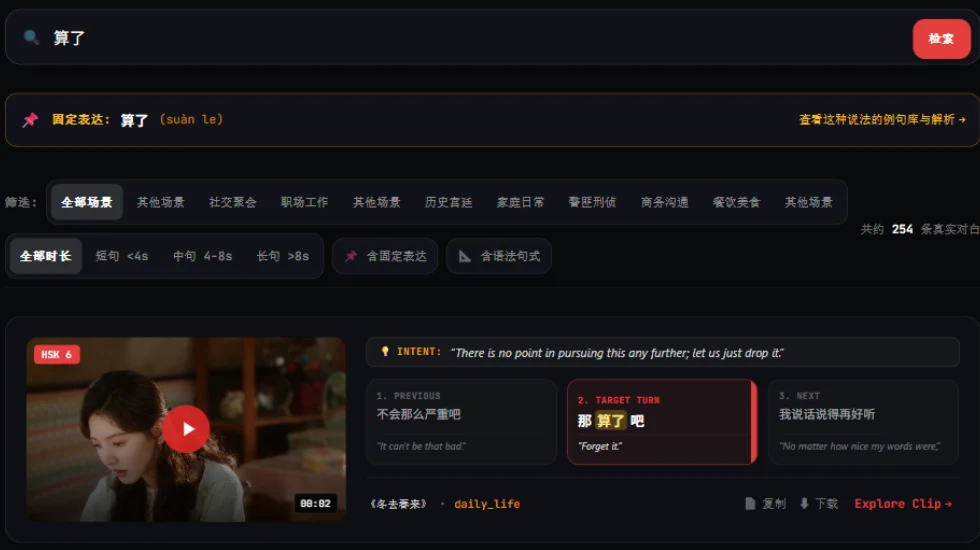
Want to see how real actors deliver these lines in different social registers? Search clips of “算了” and “没关系” across 180,000+ movie scenes on MandarinClips →