If you have ever arrived in China or tuned into a modern C-drama after years of studying HSK textbooks, you’ve likely experienced the classic “Textbook Mandarin Disconnect”:
- You expect someone to say “你好吗?我很好,谢谢你。” Instead, they say “吃了吗?” or a casual “干嘛呢?”
- When someone wants to de-escalate an awkward dispute, they don’t say “请不要介意”—they snap a sharp “算了” (suàn le).
- When someone is completely overwhelmed by exhausting complications, you won’t find the feeling in standard vocabulary lists—you will hear native speakers sigh “折腾” (zhēteng).
Standard textbooks teach you prescriptive grammar designed for academic essays and formal business meetings. They systematically ignore pragmatics (语用学): the unwritten conversational rules, ironic undertones, facial expressions, and colloquial shortcuts that native speakers rely on every single day.
To help you bridge this gap, here is our definitive curated guide to the Top 50 Chinese Colloquial Phrases, organized by social situation and paired with authentic cinema dialogue context.
Category 1: The “Deflators”
Category 1: The “Deflators” (Dismissals, De-escalations & Endings) (Dismissals, De-escalations & Endings)
These are the indispensable phrases native speakers use to cut arguments short, save face, or close awkward conversations.
1. 算了 (suàn le)
- Literal Meaning: Calculate (completed).
- Real Meaning: “Forget it” / “Never mind” / “Let it drop.”
- Native Subtext: Varies dramatically by tone. A gentle “算了” means “Don’t worry about it; it’s on me.” A sharp, clipped “算了!” indicates frustration, resignation, and an unwillingness to continue arguing.
🎬 Cinema Dialogue:
A: 我去帮你跟老板解释一下? (Should I explain it to the boss for you?)
B: 算了,越描越黑。 (Forget it, it’ll only make things worse.)
2. 至于吗 (zhìyú ma)
- Literal Meaning: Reach the point of?
- Real Meaning: “Is that really necessary?” / “Aren’t you overreacting?”
- Native Subtext: Expresses disbelief that someone is making a mountain out of a molehill.
🎬 Cinema Dialogue:
A: 我要为了这件事跟他绝交! (I’m cutting ties with him over this!)
B: 不就迟到了五分钟,至于吗? (He was just five minutes late, are you really taking it that far?)
3. 哪跟哪啊 (nǎ gēn nǎ a)
- Literal Meaning: Which and which?
- Real Meaning: “That has nothing to do with this!” / “What on earth are you talking about?”
- Native Subtext: Rejects an absurd comparison or unfounded accusation.
🎬 Cinema Dialogue:
A: 你昨天没来,是不是还在生我气? (You didn’t show up yesterday, are you still mad at me?)
B: 哪跟哪啊!我昨天加班到半夜! (Not at all, that’s completely unrelated! I worked overtime until midnight!)
4. 得了吧 (dé le ba)
- Literal Meaning: Get it (suggestion).
- Real Meaning: “Give me a break” / “Come off it.”
- Native Subtext: Directly calls out someone’s boasting or hollow promises.
🎬 Cinema Dialogue:
A: 明年我肯定能买下那套别墅。 (I’ll definitely buy that villa next year.)
B: 得了吧,你上个月的房租还没交呢。 (Give me a break, you haven’t even paid last month’s rent.)
5. 随便吧 (suíbiàn ba)
- Literal Meaning: Follow convenience.
- Real Meaning: “Whatever” / “Do as you please.”
- Native Subtext: Unlike the polite “随便” (e.g., when choosing dinner), adding the particle “吧” often implies emotional withdrawal or indifference.
6. 看着办 (kànzhe bàn)
- Literal Meaning: Watch and handle.
- Real Meaning: “Use your discretion” / “Figure it out yourself.”
- Native Subtext: When said by a boss or spouse, it is rarely an invitation for true creative freedom—it often means “You better make the choice I want.”
7. 差不多得了 (chàbùduō dé le)
- Literal Meaning: Almost sufficient.
- Real Meaning: “That’s enough” / “Stop while you’re ahead.”
- Native Subtext: Signals that someone has pushed their luck or dragged out a joke for too long.
Category 2: Grievances & Emotional Exhaustion
Chinese daily life has rich expressions for chaos, misfortune, and the friction of modern living.
8. 折腾 (zhēteng)
- Literal Meaning: Toss and turn repeatedly.
- Real Meaning: “To cause unnecessary hassle” / “To overcomplicate things” / “To burn oneself out.”
- Native Subtext: One of the most quintessential untranslatable Chinese words. It encapsulates senseless bureaucracy, pointless renovation, or relentless restlessness.
🎬 Cinema Dialogue:
A: 我们搬到郊区去住吧? (Should we move to the suburbs?)
B: 年纪大了,经不起这么折腾了。 (We’re older now, we can’t handle that kind of needless upheaval.)
9. 倒霉 (dǎoméi)
- Literal Meaning: Fall into mold.
- Real Meaning: “Rotten luck” / “Unlucky.”
- Native Subtext: Spoken when hitting unexpected, irritating bad luck (like stepping in a puddle right before an interview).
10. 烦死了 (fán sǐ le)
- Literal Meaning: Annoyed to death.
- Real Meaning: “I’m so sick of this” / “So frustrating!”
- Native Subtext: Extremely common informal vent among friends or in private monologues.
11. 吃饱了撑的 (chī bǎo le chēng de)
- Literal Meaning: Over-stuffed from eating too much.
- Real Meaning: “Doing senseless things because you have nothing better to do.”
- Native Subtext: Scathing commentary on someone looking for trouble or picking pointless fights.
🎬 Cinema Dialogue:
A: 他大半夜跑去前女友家楼下淋雨。 (He stood in the rain outside his ex’s apartment at 2 AM.)
B: 真是吃饱了撑的。 (He truly has nothing better to do with his life.)
12. 见鬼了 (jiàn guǐ le)
- Literal Meaning: Seen a ghost.
- Real Meaning: “What the heck?” / “This makes no sense.”
- Native Subtext: Uttered when something inexplicable happens, such as losing your keys on an empty desk.
13. 扯淡 (chědàn)
- Literal Meaning: Pull blandness.
- Real Meaning: “Bullshit” / “Pure nonsense.”
- Native Subtext: Northern colloquialism bluntly rejecting false claims.
14. 闹心 (nàoxīn)
- Literal Meaning: Turbulent heart.
- Real Meaning: “Distressing” / “Vexing” / “Agitating.”
- Native Subtext: Describes low-grade, persistent anxiety caused by unresolved petty problems.
Category 3: Sarcasm, Mockery & Cheekiness
Native Mandarin speakers love understated sarcasm. Here is how it sounds in cinema dialogue:
15. 想得美 (xiǎng de měi)
- Literal Meaning: Think beautifully.
- Real Meaning: “In your dreams!” / “Wishful thinking.”
🎬 Cinema Dialogue:
A: 这周末你替我值班呗? (Cover my shift this weekend, will you?)
B: 想得美! (In your dreams!)
16. 可不是嘛 (kě bù shì ma)
- Literal Meaning: How could it not be?
- Real Meaning: “Tell me about it!” / “You bet!”
- Native Subtext: Enthusiastic agreement, often tinged with shared complaining about weather, traffic, or bosses.
17. 真有你的 (zhēn yǒu nǐ de)
- Literal Meaning: Really have yours.
- Real Meaning: “You’re something else” / “I’ve gotta hand it to you.”
- Native Subtext: Can be complimentary (praising a clever workaround) or exasperated (lamenting someone’s audacious mistake).
18. 少来这套 (shǎo lái zhè tào)
- Literal Meaning: Less come this set.
- Real Meaning: “Don’t give me that” / “Save the sweet talk.”
- Native Subtext: Shuts down flattery, excuses, or emotional manipulation immediately.
19. 瞧把你给能的 (qiáo bǎ nǐ gěi néng de)
- Literal Meaning: Look at you being capable.
- Real Meaning: “Look at you, Mr. Big Shot!”
- Native Subtext: Teasing someone who is showing off or acting arrogant.
20. 太阳打西边出来了 (tàiyáng dǎ xībian chūlai le)
- Literal Meaning: The sun rose from the west.
- Real Meaning: “Pigs must be flying!” / “What a miracle!”
- Native Subtext: Expresses shock when someone uncharacteristically does something good (like a messy roommate cleaning the kitchen).
Category 4: Everyday Chinese Reactions & Social Maneuvers
Mastering these short reaction phrases makes you sound natural and fluent without needing complex grammar structures.
| # | Phrase | Pinyin | Real Meaning | Common Social Context |
|---|---|---|---|---|
| 21 | 谁说不是呢 | shéi shuō bù shì ne | “Couldn’t agree more” | Bonding over shared complaints. |
| 22 | 回头再说 | huítóu zài shuō | “Let’s talk about it later” | Polite, non-committal postponement. |
| 23 | 不好说 | bù hǎoshuō | “Hard to say” | Tactful hesitation to avoid taking sides. |
| 24 | 我说呢 | wǒ shuō ne | “No wonder!” | Realizing the missing clue to a situation. |
| 25 | 可拉倒吧 | kě lādǎo ba | “Oh, please stop” | Northeastern slang brushing off exaggeration. |
| 26 | 这叫什么事儿啊 | zhè jiào shénme shìr a | “What a mess” | Exasperation at an unfair or chaotic predicament. |
| 27 | 你懂的 | nǐ dǒng de | “You know how it is” | Shared knowing glance between friends. |
| 28 | 随你的便 | suí nǐ de biàn | “Suit yourself” | Relinquishing an attempt to advise someone. |
| 29 | 不至于吧 | bù zhìyú ba | “It can’t be that bad” | Softening someone’s dramatic fear. |
| 30 | 看情况吧 | kàn qíngkuàng ba | “We’ll see” | The ultimate soft refusal in Chinese culture. |
| 31 | 话是这么说 | huà shì zhème shuō | “That may be so, but…” | Preparing to introduce a contrasting reality. |
| 32 | 有一说一 | yǒu yī shuō yī | “To be completely honest” | Stating a fair, unbiased judgment. |
| 33 | 没门儿 | méi ménr | “Not a chance!” | Firm, colloquial rejection. |
| 34 | 图什么呢 | tú shénme ne | “What’s the point?” | Questioning someone’s self-destructive efforts. |
| 35 | 多大点事儿 | duō dà diǎn shìr | “No big deal” | Brushing off a minor mishap to comfort a friend. |
Category 5: Conversational Glue & Fillers
Fluency isn’t just knowing big words; it’s mastering the natural pauses native speakers use while thinking.
| # | Phrase | Pinyin | Real Meaning & Function |
|---|---|---|---|
| 36 | 就是说 | jiù shì shuō | “Exactly” / “In other words” (frequently used as an agreement filler). |
| 37 | 怎么说呢 | zěnme shuō ne | “How should I put it…” (buying time during a nuanced explanation). |
| 38 | 话说回来 | huà shuō huílái | “Then again…” / “On the other hand…” |
| 39 | 说实话 | shuō shíhuà | “To tell you the truth…” |
| 40 | 不管怎么说 | bùguǎn zěnme shuō | “At any rate…” / “No matter what…” |
| 41 | 闹了半天 | nàole bàntiān | “Turns out that all along…” (discovering the true reason). |
| 42 | 话说 | huàshuō | “By the way…” (opening a casual topic in chat). |
| 43 | 那倒也是 | nà dào yě shì | “Fair enough” / “I suppose that’s true.” |
| 44 | 老实交代 | lǎoshi jiāodài | “Come clean!” / “Spill the tea!” (playful interrogation). |
| 45 | 爱咋咋地 | ài zǎ zǎ de | “I couldn’t care less what happens” (total resignation). |
| 46 | 打住 | dǎzhù | “Stop right there!” (pausing someone before they overshare). |
| 47 | 没眼看 | méi yǎn kàn | “Too cringe to watch” (secondhand embarrassment). |
| 48 | 何必呢 | hébì ne | “Why put yourself through that?” |
| 49 | 谁懂啊 | shéi dǒng a | “Does anyone else get this?” (popular modern empathy opener). |
| 50 | 歇了吧 | xiē le ba | “Give it a rest” (telling someone to stop trying). |
How to Internalize Spoken Chinese Without Sounding Weird
Memorizing a list of slang words is dangerous if you don’t know who you can say them to. Saying “得了吧” to your mother-in-law or university dean will get you in serious trouble, whereas using it with a classmate proves genuine intimacy.
To acquire authentic conversational timing:
- Observe the Social Register: Always note the hierarchical relationship between characters in Chinese cinema before adopting a phrase.
- Watch the Facial Tone: Half of the meaning of “算了” or “至于吗” comes from eye rolls, sighing, or body posture.
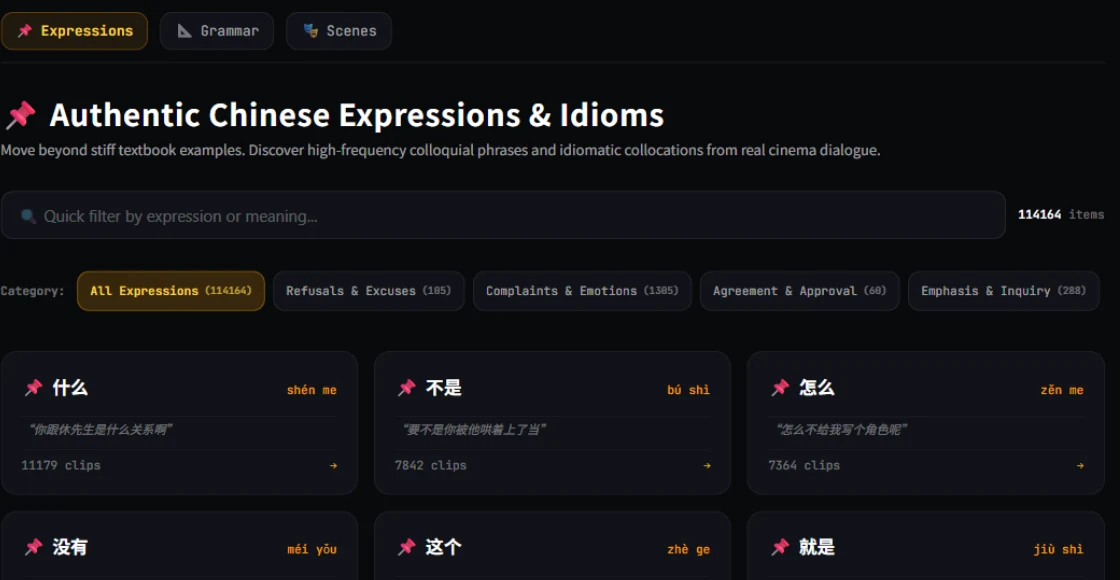
- Use Reverse Search: When in doubt, look up the word on MandarinClips. Seeing 10 different movie clips of a single phrase in seconds gives you an intuitive understanding of the emotional context that no dictionary definition can match.
Ready to hear these in real cinema dialogue?
Don’t just read the words—hear real native actors speak them in context. Search any colloquial phrase on MandarinClips for free →