If you’ve ever tried using Language Reactor (formerly Language Learning with Netflix / LLN) to learn Chinese, you already know the promise: watching authentic Chinese television and films with dual interactive subtitles, hover-to-define pinyin, and keyboard navigation.
In practice, however, Mandarin learners using Language Reactor hit several frustrating roadblocks:
- The “Missing Subtitle” Dilemma: Netflix’s Chinese catalog varies wildly by region, and many shows only provide simplified Chinese subtitles without accurate machine-readable timing or faithful pinyin.
- Passive Watching vs. Active Retrieval: Language Reactor lets you watch a single movie from start to finish. But what if you encounter a tricky colloquial phrase like “折腾” (zhēteng) or “算了” (suàn le) and want to see how ten different native speakers use it across different scenes? Language Reactor can’t do that.
- The Subtext Blindspot: Textbooks and automated dictionary popups give you literal translations. They cannot tell you that when a character says “慢走” (literally “walk slowly”), they are actually saying “goodbye”, or that “至于吗” conveys biting irony.
Whether you are tired of browser extension glitches, seeking dedicated mobile immersion, or need a tool that lets you search dialogue across authentic Chinese cinema, here is the definitive comparison of the 6 best Language Reactor alternatives for Mandarin Chinese learners in 2026.
Quick Comparison: Best Language Reactor Alternatives for Mandarin
| Tool | Best For | Core Advantage | Pricing | Platform |
|---|---|---|---|---|
| MandarinClips | Cinema Concordancing & Pragmatics | 180k+ searchable dialogue clips, HSK 3.0 tags, 3-turn context & native subtexts | Free tier / Affordable Pro | Web, Mobile-Friendly |
| FluentU | Curated Short Music & Ads | Polished video lessons with built-in quizzes | $29.99 / month | Web, iOS, Android |
| Migaku | Dedicated Anki Sentence Miners | Complete 1-click Anki card generation from streaming | $10 / month (or annual) | Chrome Extension, Mobile |
| Yabla Chinese | Traditional Dual-Sub Practice | Proprietary slowdown audio & slow-pitch tech | $12.95 / month | Web, iOS |
| Trancy | Modern AI-Powered Dual Subtitles | AI sentence explanations & bilingual YouTube/Netflix UI | Free tier / $3.99+ mo | Chrome/Edge, Mobile App |
| Du Chinese | Graded Reading (Text Alternative) | Carefully controlled HSK stories with human voiceover | Free tier / $14.99 mo | Web, iOS, Android |
1. MandarinClips: The Ultimate Cinema Dialogue Search Engine
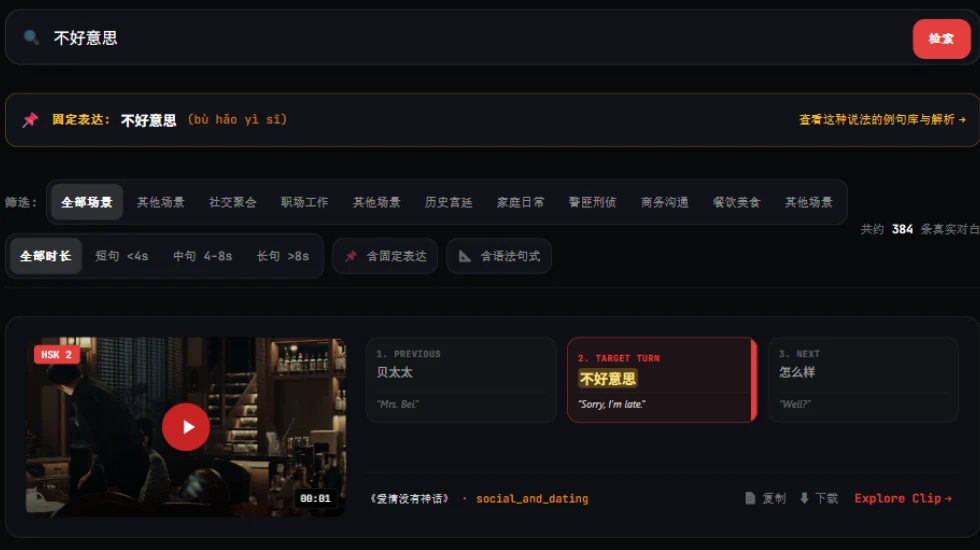
While most tools on this list are media players that layer subtitles on top of long streaming videos, MandarinClips takes a completely different, pedagogically superior approach: it is a linguistic cinema corpus and pedagogical concordancer tailored specifically for Mandarin learners and Chinese educators.
Instead of hunting through hours of C-dramas hoping to bump into a specific grammar pattern, MandarinClips indexes over 180,000 authentic movie and TV dialogue clips (~3 seconds each). You type in any Chinese character, vocabulary word, or HSK grammar formula, and it instantly serves up real native clips accompanied by 3-turn dialogue context, accurate pinyin, and English translations.
Where It Beats Language Reactor:
- Instant Sentence Mining & Concordancing: Search for words like “折腾”, “倒霉”, or “至于吗”, and immediately watch 20+ authentic film examples of that exact phrase being spoken in real life.
- Pragmatic & Cultural Subtexts (潜台词): This is MandarinClips’ superpower. Automated dictionaries only translate literal words. MandarinClips explains the speaker’s true conversational intent—face-saving, sarcasm, reluctance, or emotional nuance.
- Official HSK 3.0 Bands: Every scene is categorized by difficulty (from HSK 1 up to HSK 7-9), allowing you to filter clips that fit your exact comprehensible input level.
- Native AI & MCP Support: For teachers and power learners, MandarinClips offers an official Model Context Protocol (MCP) server, allowing you to feed authentic video citations directly into Claude or lesson-planning workflows.
🎬 Real Example from MandarinClips:
Scene Context: Two colleagues arguing over a cancelled client meeting.
Speaker A: 这件事明摆着是他在推脱,你还要去替他背锅?
Speaker B: 算了,闹僵了对大家都没好处。
- Pinyin: Suàn le, nào jiāng le duì dàjiā dōu méi hǎochu.
- Literal Translation: Forget it, reaching an impasse does no good for anyone.
- Pragmatic Subtext: The speaker uses “算了” not because they agree or are happy, but as a deliberate de-escalation tactic to save professional face and prevent interpersonal conflict.
- Best For: Intermediate and advanced learners (HSK 3-9) wanting to speak like native speakers, as well as Chinese teachers looking for authentic classroom examples.
2. FluentU: Structured Lessons for Beginners
FluentU has been around for over a decade. It curates real-world Mandarin videos—commercials, music videos, news segments, and cartoon clips—and turns them into structured language lessons.
Pros:
- Professionally graded video clips categorized by difficulty.
- Interactive subtitle hover states that pause playback automatically.
- Built-in spaced repetition quizzes after every video.
Cons:
-
Hefty Price Tag: At nearly $30/month, it is one of the most expensive tools on the market.
-
Dated Library: Much of the Chinese video library consists of older commercials and children’s content rather than contemporary, binge-worthy Chinese cinema.
-
Best For: Early beginners who want guided, bite-sized video lessons and don’t mind the premium subscription.
3. Migaku: The Power Tool for Anki Sentence Miners
If your primary reason for using Language Reactor is exporting 1-click Anki flashcards with audio and video screenshots, Migaku is the current community gold standard.
Pros:
- Seamless integration with Anki: creates cards complete with sentence audio, target word definitions, and video snapshots with a single hotkey.
- Works across Netflix, YouTube, and local video files.
- Includes a robust pitch accent and tone-coloring system.
Cons:
-
Steep Learning Curve: Setup requires installing browser extensions, configuring Anki decks, and tweaking dictionary preferences.
-
Passive Consumption Trap: Like Language Reactor, you must already have a specific show queued up. It does not allow you to reverse-search a word across a vast cinema database.
-
Best For: Dedicated SRS enthusiasts who build personalized Anki sentence decks from Netflix.
4. Yabla Chinese: Dual Subtitles with Slow Audio Mastery
Yabla is another veteran platform designed specifically for language learning via video.
Pros:
- Patented Slow-Pitch Audio: Slows down fast-talking native speakers without distorting the pitch or tone of the Mandarin syllables.
- Integrated transcription and dictation games (Scribe mode) that force you to listen closely to every syllable.
Cons:
-
Outdated UI: The interface feels stuck in the early 2010s.
-
Limited Modern Film Selection: Videos are mostly documentary shorts, street interviews, and scripted instructional sketches rather than popular C-dramas.
-
Best For: Learners struggling with rapid native speech segmentation who want rigorous dictation exercises.
5. Trancy: The Modern AI Alternative to Language Reactor
Trancy is the newest challenger directly targeting Language Reactor’s extension model. Built from the ground up for modern AI workflows, it layers over YouTube and Netflix.
Pros:
- Modern, sleek interface with customizable bilingual subtitle displays.
- AI-driven grammar explanations for individual sentences on hover.
- Excellent cross-platform companion app for reviewing saved phrases on mobile.
Cons:
-
Still bound to the limitations of streaming platform catalogs and subtitle availability.
-
AI translations can occasionally hallucinate colloquial Mandarin nuances.
-
Best For: Learners looking for a direct, modern drop-in replacement for Language Reactor on Netflix and YouTube.
6. Du Chinese: The Graded Reading Counterpart
While Du Chinese is a reading application rather than a video player, it deserves a spot on this list because many learners turn to video tools simply because they are searching for authentic, accessible context.
Pros:
- Superb graded stories ranging from HSK 1 to HSK 9 with natural native voice narration.
- Clean, distraction-free reading experience with instant audio playback.
Cons:
-
No Real Video Context: You miss out on visual facial expressions, cinematic body language, and natural spoken cadences found in real television.
-
Best For: Learners who want to balance their video immersion with disciplined, text-based graded reading.
Which Tool Should You Choose?
- If you want a direct replacement for watching entire Netflix episodes with dual subtitles and AI grammar parsing, go with Trancy.
- If your goal is building an Anki sentence bank from full-length shows, choose Migaku.
- If you want to break free from rigid textbook Mandarin, search how words are actually spoken in 180,000+ real movie clips, and understand the subtext and cultural nuance of daily Chinese, MandarinClips is the most focused and powerful tool available.
Ready to experience authentic Chinese dialogue?
Stop relying on robotic textbook audio. Try searching any Chinese word on MandarinClips for free and see real native actors speak it in context today.