In late 2008, Chinese political speechwriters presented the world’s diplomatic translators with an impossible riddle. During an official keynote addressing the nation’s modernization, the government announced the core principle of “不折腾” (bù zhēteng).
Major international news outlets panicked. The New York Times, BBC, and international linguists spent weeks debating how to translate it:
- “Do not get sidetracked?”
- “Avoid self-inflicted chaos?”
- “Don’t flip-flop or cause unnecessary agitation?”
Eventually, many official Chinese diplomatic releases gave up and simply transliterated it as “Buzheteng”.
If world-class interpreters struggle with 折腾 (zhēteng), it is no surprise that intermediate Mandarin learners find it bewildering. Standard dictionaries offer stiff definitions like “to toss from side to side,” “to torment,” or “to do something repeatedly.”
Yet in daily life, native speakers use “折腾” to describe everything from a frustrating apartment move to restless startup ambition.
Here is the definitive guide to mastering the many emotional layers of 折腾 (zhēteng) using authentic cinema dialogue.
The Physical Origin: Tossing and Turning
To understand “折腾”, look at its two characters:
- 折 (zhē): To bend, fold, or turn over.
- 腾 (teng): To soar, jump, or agitate.
Its original, literal meaning describes someone who cannot fall asleep and tosses restlessly in bed:
“他昨天胃疼,在床上折腾了一整夜。”
(He had a stomachache yesterday and tossed and turned in bed all night.)
From this root sensation of restless physical agitation without rest, Mandarin speakers evolved the word into one of the most culturally loaded pragmatic terms in the language.
The 4 Social Layers of 折腾 in Modern Chinese
[https://www.mandarinclips.com/og-image.jpg]
1. Pointless Friction & Overcomplication (瞎折腾)
When someone creates unnecessary work, changes plans five times for no reason, or buys complicated gadgets they never use, they are engaging in 瞎折腾 (xiā zhēteng).
🎬 Cinema Dialogue: Pointless Upheaval
Context: An older couple reacting to their son wanting to remodel an already functional kitchen.
Father: 房子好端端的,你又要敲墙又要换地砖,这不是瞎折腾吗?
- Pinyin: Fángzi hǎoduānduān de, nǐ yòu yào qiāo qiáng yòu yào huàn dìzhuān, zhè bù shì xiā zhēteng ma?
- English: The apartment is in perfectly good shape, and now you want to knock down walls and replace tiles. Isn’t this just needlessly creating trouble?
- Pragmatic Subtext: The father views home renovation not as an upgrade, but as an exhausting, disruptive waste of energy.
2. Physical & Logistical Exhaustion (经不起折腾)
Moving across town in heavy rain, taking three connecting buses with bulky luggage, or dealing with tedious bureaucratic paperwork is described as being “折腾死人” (exhausted to death by hassle).
🎬 Cinema Dialogue: Age and Weariness
Context: Two retired friends deciding whether to join a fast-paced tourist tour group.
Speaker A: 咱们还是报个自由行的团吧,坐大巴赶早班飞机,这把年纪真经不起折腾了。
- Pinyin: Zánmen háishì bào ge zìyóuxíng de tuán ba, zuò dàbā gǎn zǎobān fēijī, zhè bǎ niánjì zhēn jīngbuqǐ zhēteng le.
- English: Let’s just book a flexible private tour. Riding buses and catching early-morning flights—at our age, we really can’t endure this kind of exhausting strain.
3. Restless Ambition & Entrepreneurial Grit (敢折腾 / 能折腾)
Here is the fascinating paradox: “折腾” is not always negative.
When applied to young founders, artists, or innovators who refuse to settle into a safe, boring 9-to-5 desk job, “能折腾” (capable of shaking things up) becomes a badge of honor. It denotes hunger, grit, and the courage to take risks.
🎬 Cinema Dialogue: The Startup Spirit
Context: A mentor speaking about a gritty young entrepreneur who failed twice before succeeding.
Mentor: 这小伙子骨子里有股劲儿,不怕输,敢折腾。
- Pinyin: Zhè xiǎohuǒzi gǔzi lǐ yǒu gǔ jìnr, bù pà shū, gǎn zhēteng.
- English: This young man has real grit in his bones. He isn’t afraid to fail, and he’s willing to take risks and hustle.
4. Tormenting and Giving Someone a Hard Time (折腾人)
When someone acts demanding, fickle, or unreasonable—putting subordinates or partners through endless hurdles—they are “折腾别人”.
🎬 Cinema Dialogue: Workplace Friction
Colleague A: 方案改了第八版了,客户还是不满意。 (This is the eighth revision of the proposal, and the client is still dissatisfied.)
Colleague B: 这明摆着就是故意折腾人。 (They’re clearly just giving us a hard time on purpose.)
Must-Know High-Frequency Collocations
| Phrase | Pinyin | Real Spoken Meaning |
|---|---|---|
| 别折腾了 | bié zhēteng le | “Stop overcomplicating things” / “Give it a rest.” |
| 折腾半天 | zhēteng bàntiān | “Spent hours wrestling with a problem (often with little result).” |
| 图个不折腾 | tú ge bù zhēteng | “Just want an easy, quiet life without drama.” |
| 何必折腾呢 | hébì zhēteng ne | “Why put yourself through all that unnecessary grief?” |
| 折腾不动了 | zhēteng bù dòng le | “I no longer have the energy/youth to deal with this chaos.” |
How to Tell the Difference: 折腾 vs 麻烦 vs 累
Many learners wonder why they can’t just use 麻烦 (máfan) or 累 (lèi):
- 累 (lèi): Describes the pure physical sensation of fatigue (“I ran 10km, I’m tired”).
- 麻烦 (máfan): Describes a single inconvenient task or obstacle (“Filling out this form is troublesome”).
- 折腾 (zhēteng): Describes a prolonged, dynamic process of chaos, repetitive trial-and-error, or emotional agitation (“I spent the entire weekend wrestling with furniture assembly, landlord disputes, and broken elevators”).
Hear “折腾” Delivered with Native Emotion
No definition on paper can replicate the exasperated sigh of an exhausted Beijing taxi driver saying “真够折腾的”, or the proud smile of an entrepreneur saying “年轻人就得折腾”.
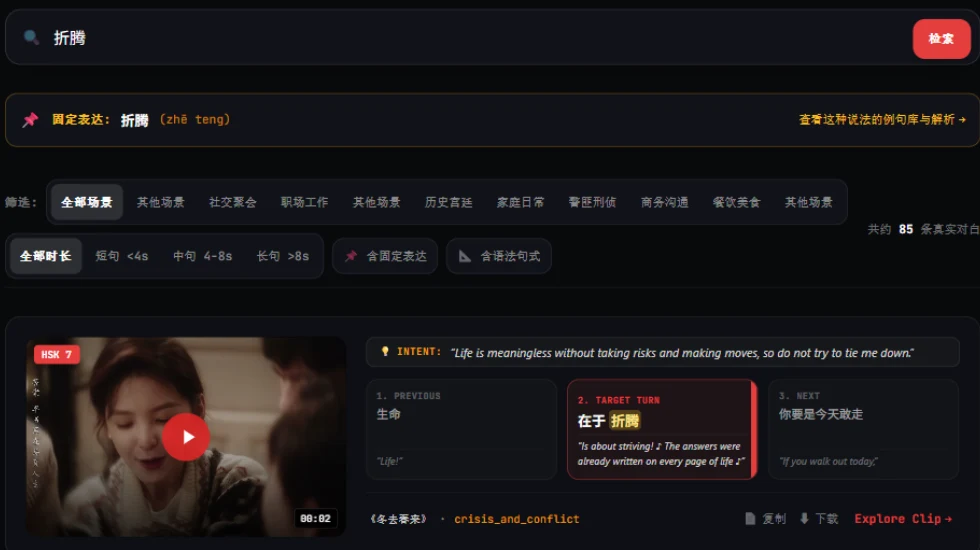
Want to see how real actors deliver this word across dozens of emotional registers?
👉 Search 50+ real cinema scenes containing “折腾” on MandarinClips →