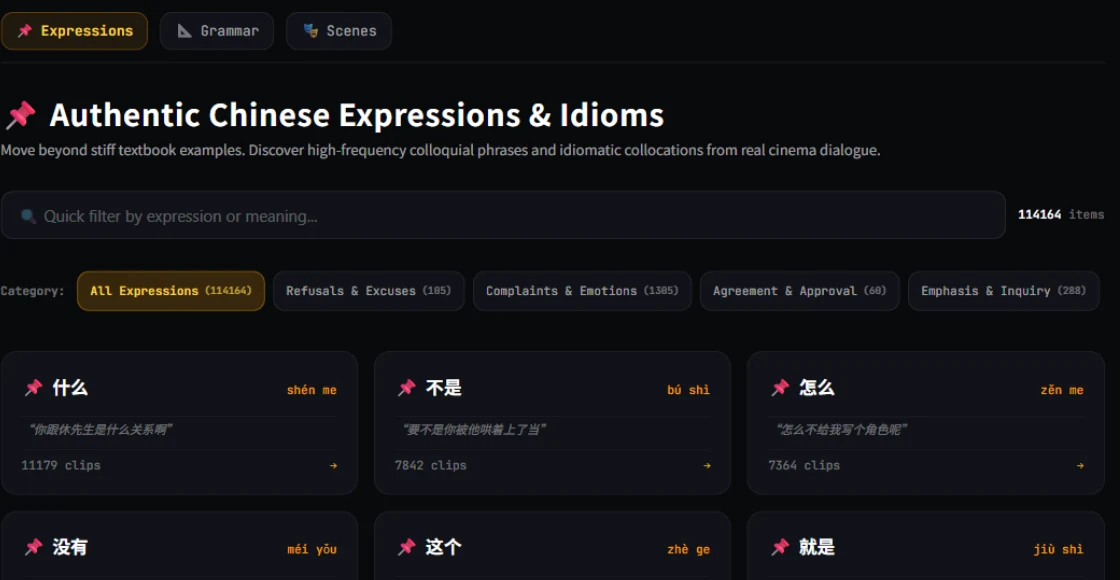
MC
MandarinClips Cinema Corpus
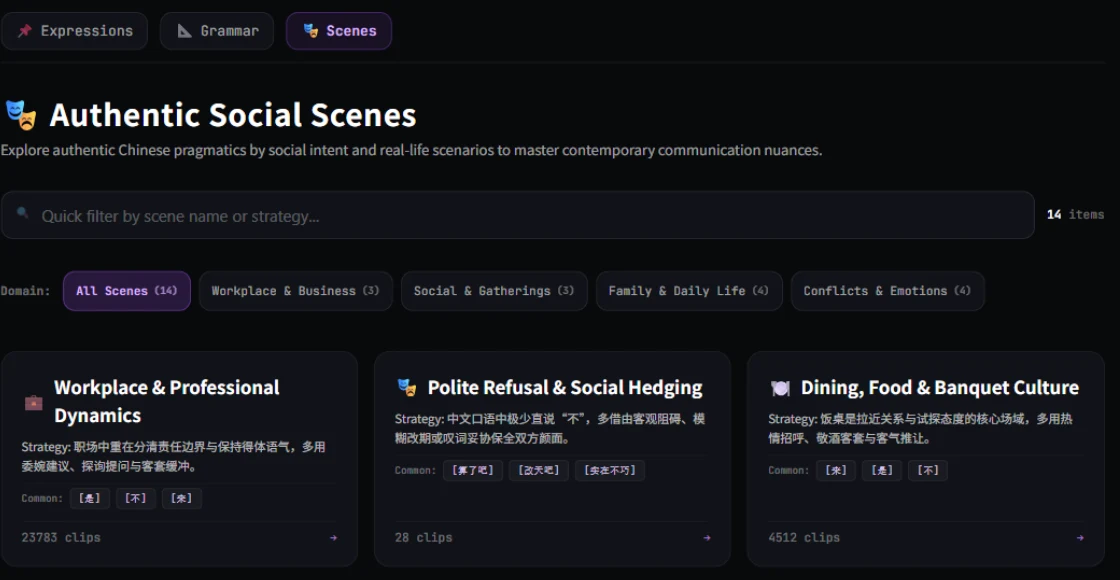
How to Say No in Chinese: The Art of Face (面子) and Polite Refusals

How to Say "No" in Chinese: The Art of Face (面子) and Polite Refusals

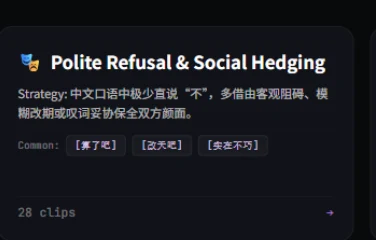
In Western business and social communication, directness is valued: “No, I cannot attend,” or “I disagree with that proposal.” In Mandarin Chinese, however, delivering a blunt, naked “不” (bù) to an invitation or business request is the conversational equivalent of slamming a door in someone’s face. It violates the core pillar of Chinese interpersonal pragmatics: Saving Face (面子 / miànzi). When you deliver a flat rejection, you do not just decline a request—you publicly strip the requester of their social dignity, leaving both parties embarrassed (难堪). ...
November 3, 2026 · 3 min · MandarinClips Team
Sentence Mining Chinese from Movies with Anki: The Definitive 2026 Guide

Sentence Mining Chinese from Movies with Anki: The Definitive 2026 Guide

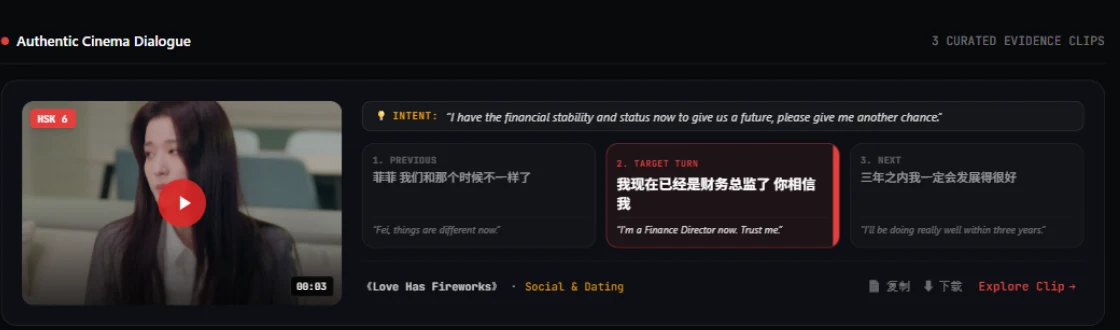
If you follow evidence-based language acquisition methodologies like Refold, Mass Immersion Approach (MIA), or Krashen’s Comprehensible Input hypothesis, you already know the power of Sentence Mining (句型挖掘). Instead of memorizing isolated vocabulary lists, sentence mining involves capturing target words inside 1T (Target + 1 unknown word) sentences directly from native media you enjoy. However, anyone who has tried mining sentences from full-length Chinese television shows knows how tedious the manual workflow can be: ...

November 3, 2026 · 3 min · MandarinClips Team

The 414 HSK 3.0 Chengyu in Real Cinema: How Native Speakers Actually Use Idioms

In the official HSK 3.0 syllabus, exactly 414 four-character idioms (成语, chéngyǔ) are distributed across the intermediate and advanced bands. For most non-native learners, studying Chengyu is an exercise in frustration: Dictionaries give you a 500-word historical myth from the Warring States period (“A man bought a spear and a shield in the State of Chu…”). Sample sentences read like formal academic thesis papers from the 1950s. When you try using a newly memorized idiom in casual conversation, native friends laugh because you sound like an ancient poet trying to order a boba tea. Here is the secret native speakers know: Chengyu are not just for ancient poetry—they are high-efficiency emotional shortcuts in daily spoken Chinese. ...

November 3, 2026 · 5 min · MandarinClips Team
Du Chinese vs MandarinClips: Graded Reading vs Cinema Immersion (2026 Comparison)

Du Chinese vs MandarinClips: Graded Reading vs Cinema Immersion (2026 Comparison)

If you ask Mandarin communities on Reddit or Discord for the best app to build vocabulary, Du Chinese is almost always at the top of the recommendation list. With its meticulously leveled graded stories (from newbie to HSK 9) and professional voice-actor recordings, Du Chinese has solved the problem of extensive reading for thousands of learners. However, many learners who spend months reading Du Chinese stories run headfirst into the “Literacy Trap”: ...

November 3, 2026 · 5 min · MandarinClips Team
How to Learn Chinese from C-Dramas (Cdrama): The Ultimate 2026 Immersion Routine

How to Learn Chinese from C-Dramas (Cdrama): The Ultimate 2026 Immersion Routine

Chinese television dramas (C-dramas) are arguably the richest source of natural, contemporary Mandarin input on the planet. From family sagas like 《都挺好》 (All Is Well) to atmospheric thrillers like 《隐秘的角落》 (The Bad Kids), modern shows expose you to how Chinese speakers truly laugh, argue, negotiate, and fall in love. Yet hundreds of thousands of learners fall into the classic “Subtitle Illusion”: You curl up on the couch to watch 40 episodes of a gripping drama on Netflix or Viki. You keep dual subtitles or English subtitles turned on. At the end of the season, your brain followed the plot perfectly, but your spoken Mandarin hasn’t improved by a single percentage point. Watching full-length dramas without a framework is like swimming in an open ocean without knowing how to paddle—you drown in rapid native speech. ...

November 3, 2026 · 5 min · MandarinClips Team
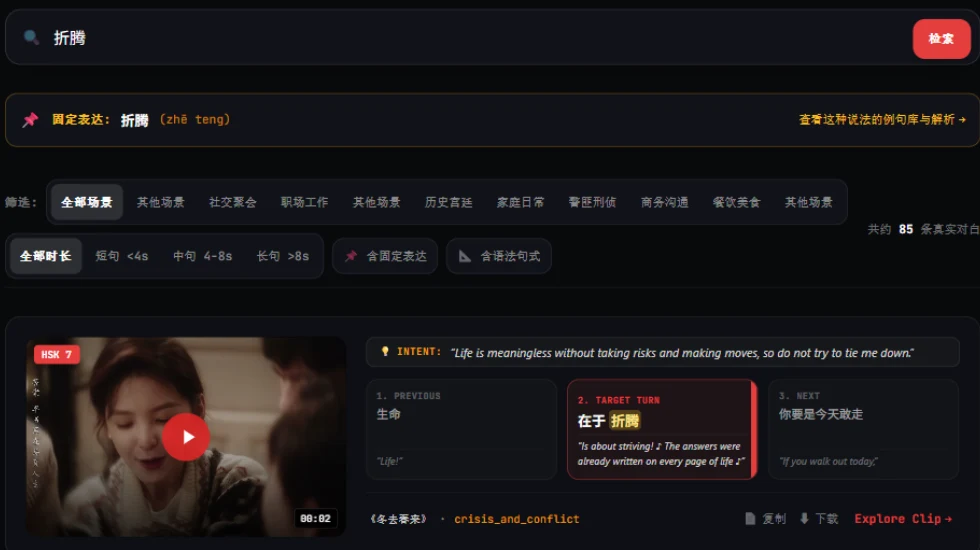
The Many Meanings of 折腾 (Zhēteng): How Native Speakers Actually Use It (With Movie Clips)

The Many Meanings of 折腾 (Zhēteng): How Native Speakers Actually Use It (With Movie Clips)

In late 2008, Chinese political speechwriters presented the world’s diplomatic translators with an impossible riddle. During an official keynote addressing the nation’s modernization, the government announced the core principle of “不折腾” (bù zhēteng). Major international news outlets panicked. The New York Times, BBC, and international linguists spent weeks debating how to translate it: “Do not get sidetracked?” “Avoid self-inflicted chaos?” “Don’t flip-flop or cause unnecessary agitation?” Eventually, many official Chinese diplomatic releases gave up and simply transliterated it as “Buzheteng”. ...

November 2, 2026 · 5 min · MandarinClips Team
FluentU Chinese Alternatives: 5 Better (and Cheaper) Ways to Learn with Video in 2026

FluentU Chinese Alternatives: 5 Better (and Cheaper) Ways to Learn with Video in 2026

If you have researched learning Chinese through real-world video, you have undoubtedly run into FluentU. FluentU’s marketing pitch is compelling: learn Mandarin naturally by watching authentic music videos, commercials, movie trailers, and news clips with clickable interactive subtitles and spaced repetition quizzes. However, once learners sign up for the free trial, two major issues consistently surface: The Prohibitive Price Tag: At $29.99 per month (or roughly $240/year when billed annually), FluentU costs more than subscriptions to Netflix, Disney+, and HBO Max combined. For students, language hobbyists, and self-directed learners, this pricing is simply unreasonable. Dated, Fragmented Content: A significant portion of FluentU’s Chinese library consists of decade-old commercials, children’s cartoons, or isolated 60-second YouTube clips. You rarely hear contemporary cinematic dialogue, and you certainly don’t get exposed to the conversational flow of modern C-dramas. If you are looking for a more cost-effective, modern, and pedagogically sound way to master Mandarin through video, here are the 5 best FluentU Chinese alternatives in 2026. ...

November 2, 2026 · 6 min · MandarinClips Team
How to Master HSK 3.0 with Authentic Cinema: The Complete 9-Level Guide (2026)

How to Master HSK 3.0 with Authentic Cinema: The Complete 9-Level Guide (2026)

The transition to the HSK 3.0 standard (Chinese Proficiency Grading Standards for International Chinese Language Education) has completely reshaped the landscape of learning Mandarin: The total vocabulary requirement across all bands surged from 5,000 words (HSK 2.0) to over 11,000 words. The old 6-level system expanded into 3 stages and 9 levels (Elementary, Intermediate, and Advanced HSK 7-9). Most importantly, the testing philosophy shifted: sterile textbook grammar is no longer enough. Test questions now incorporate natural spoken cadence, idiomatic reactions, and realistic communicative tasks. If your study plan consists solely of flipping through static flashcard decks or reading formulaic dialogues about “小明买苹果”, you will hit an insurmountable barrier on the listening and descriptive sections. ...

November 2, 2026 · 5 min · MandarinClips Team
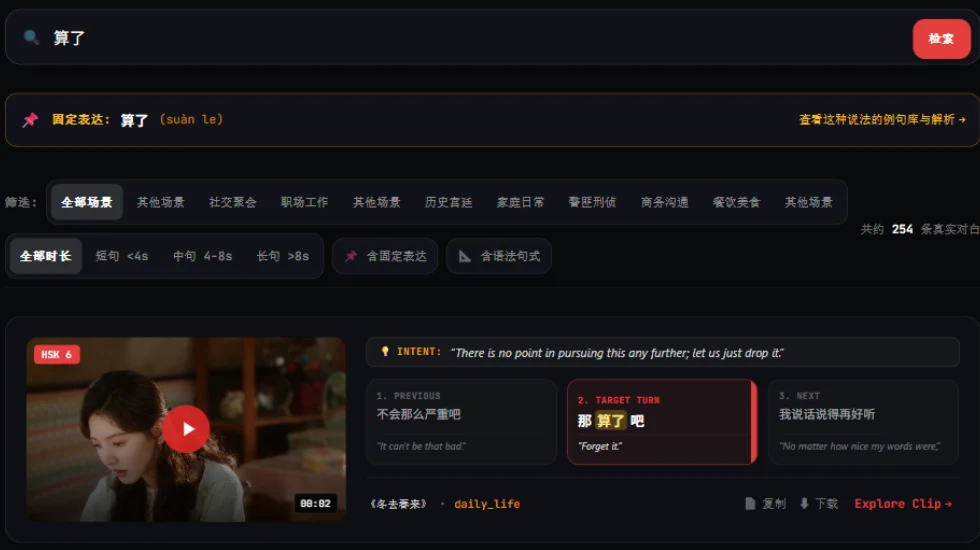
How to Say Never Mind in Chinese: 算了 vs 没关系 vs 不用了 (With Real Movie Clips)

How to Say "Never Mind" in Chinese: 算了 vs 没关系 vs 不用了 (With Real Movie Clips)

In English, the phrase “never mind” is a universal multi-tool. You can use it to: Forgive someone who accidentally bumps your elbow (“Never mind, it’s fine”). Drop a point when someone can’t hear you over loud music (“Never mind, I’ll tell you later”). Politely decline a second cup of coffee (“Never mind, I’m good”). Show sharp annoyance when an argument goes nowhere (“Never mind! Forget I even brought it up!”). If you try to translate all of these with a single Chinese phrase, you will run into awkward cultural misunderstandings. ...

November 2, 2026 · 5 min · MandarinClips Team
Top 50 Chinese Colloquial Phrases You'll Never Learn in Textbooks (With Cinema Context)

Top 50 Chinese Colloquial Phrases You'll Never Learn in Textbooks (With Cinema Context)

If you have ever arrived in China or tuned into a modern C-drama after years of studying HSK textbooks, you’ve likely experienced the classic “Textbook Mandarin Disconnect”: You expect someone to say “你好吗?我很好,谢谢你。” Instead, they say “吃了吗?” or a casual “干嘛呢?” When someone wants to de-escalate an awkward dispute, they don’t say “请不要介意”—they snap a sharp “算了” (suàn le). When someone is completely overwhelmed by exhausting complications, you won’t find the feeling in standard vocabulary lists—you will hear native speakers sigh “折腾” (zhēteng). Standard textbooks teach you prescriptive grammar designed for academic essays and formal business meetings. They systematically ignore pragmatics (语用学): the unwritten conversational rules, ironic undertones, facial expressions, and colloquial shortcuts that native speakers rely on every single day. ...

November 2, 2026 · 9 min · MandarinClips Team